E-mail: John@xhgraphite.com
WhatsApp: +86-18663987730
E-mail: John@xhgraphite.com
WhatsApp: +86-18663987730

News
Micro-powder graphite is the same mineral as flake graphite, taken through milling and classification until the particle size sits in the micron range. What changes is not the chemistry but the geometry: shorter travel between particles, far more surface per kilogram, and a size distribution that has to be controlled rather than inherited from the mine.
Buyers who treat micro-powder as a commodity usually specify it with one number, often d50. That single number is where most purchase disputes start. This note sets out what each field on a micro-powder data sheet actually decides, and how to compare two grades before you put them into a process.
Flake graphite is sold on mesh, fixed carbon and ash, and its performance in a mix depends heavily on platelet size and how the platelets orient. Micro-powder is sold on a measured curve, and its performance depends on how evenly that curve is reproduced from lot to lot. In a flake grade the coarse end carries the load; in a micro-powder grade the fine end dominates, because at these sizes surface area, not mass, drives the behaviour you see.
That shift has two practical consequences. First, two powders with the same d50 can behave differently if one carries a long fine tail. Second, moisture and agglomeration matter far more at micron sizes, because a small amount of water changes how the powder flows and disperses.
In practice d50 is the field that tells you whether a grade is even in the right family for your process. A fine powder suits a thin film or a dispersion; a coarser powder suits a mix that has to carry load or fill volume. Get this wrong and no amount of purity fixes it.
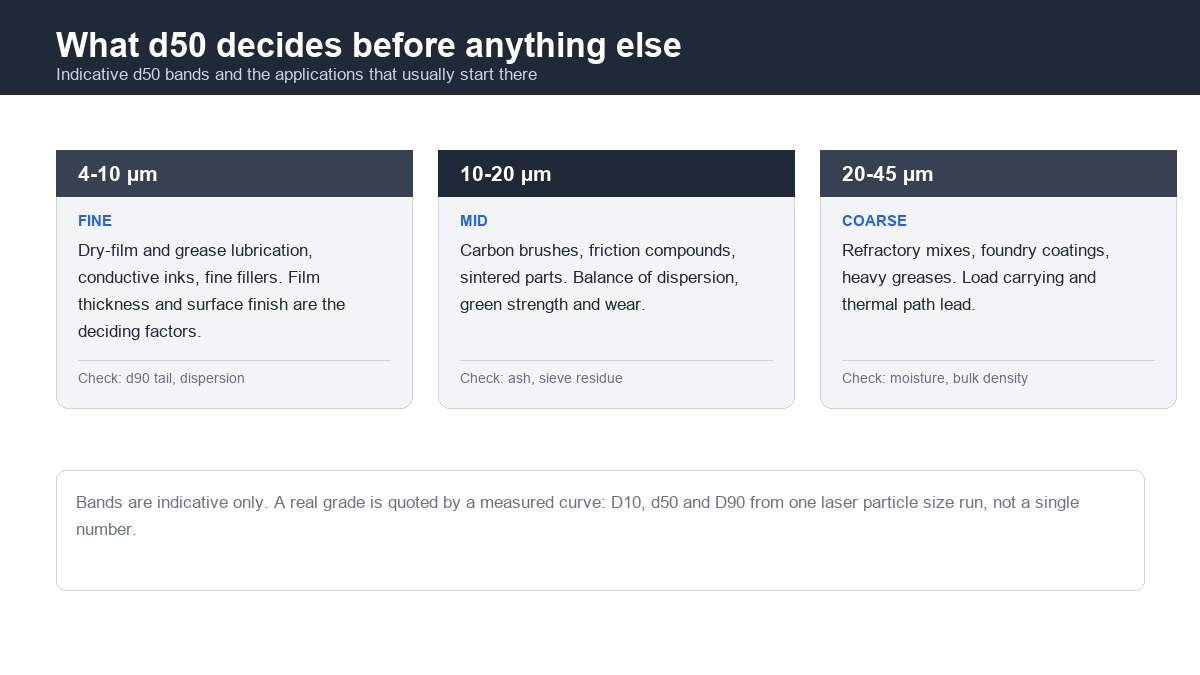
Figure 1. Indicative bands only; a real grade is quoted as a measured curve.
Our own ranges run from 4 to 35 microns on the MGF series and 10 to 45 microns on the MGR series, both measured on a laser particle size analyser. Those are the ends of the range, not a promise that every point in between behaves the same way. The grade you buy sits somewhere on that range, and the curve around it is what your process actually meets.
| Application | Typical starting band | Field to fix first |
|---|---|---|
| Dry-film and grease lubrication | 4-10 µm | D90, the coarse end that breaks the film |
| Carbon brushes | 10-20 µm | Ash and the fine fraction together |
| Conductive inks and coatings | 4-15 µm | Dispersion and moisture |
| Powder metallurgy, friction mixes | 10-25 µm | Carbon range stability lot to lot |
| Refractory mixes, foundry coatings | 20-45 µm | Moisture and handling |
Table 1. Starting bands for comparison only. Each application is defined by its own trial, and the band moves with binder, carrier and contact pressure.
Three numbers describe a distribution well enough for purchasing: D10, d50 and D90. D10 tells you how much fine material you carry, d50 is the midpoint, D90 sets the coarse end. The distance between D10 and D90 relative to d50 is the span, and span is the number that predicts how consistent the powder will feel in use.
A wide span means the powder contains both a fine fraction and a coarse one. That is not automatically bad; in some mixes a wide band packs better. But it does mean the behaviour is no longer set by one size, and a change of supplier with the same d50 can shift the whole balance. Mesh size and particle size distribution are two different languages for the same idea, and mixing them up is the most common specification error we see.
Purity on a micro-powder data sheet usually means carbon content, and it can be quoted anywhere from about 90% to 99.99% depending on the process the powder has been through. The question is not which number is better in general, but what the non-carbon fraction does in your application.
Paying for 99.9% when your process can absorb 95% is a real cost with no return. The reverse error costs more: buying on price and discovering the ash load changes your wear rate. Our note on fixed carbon sets out how to read the trade-off without treating the highest number as the best one.
Understanding the process explains why two suppliers quoting the same d50 can deliver different powders. Micro-powder is not simply ground flake; it is ground, classified and tested, and each step leaves a fingerprint on the curve.
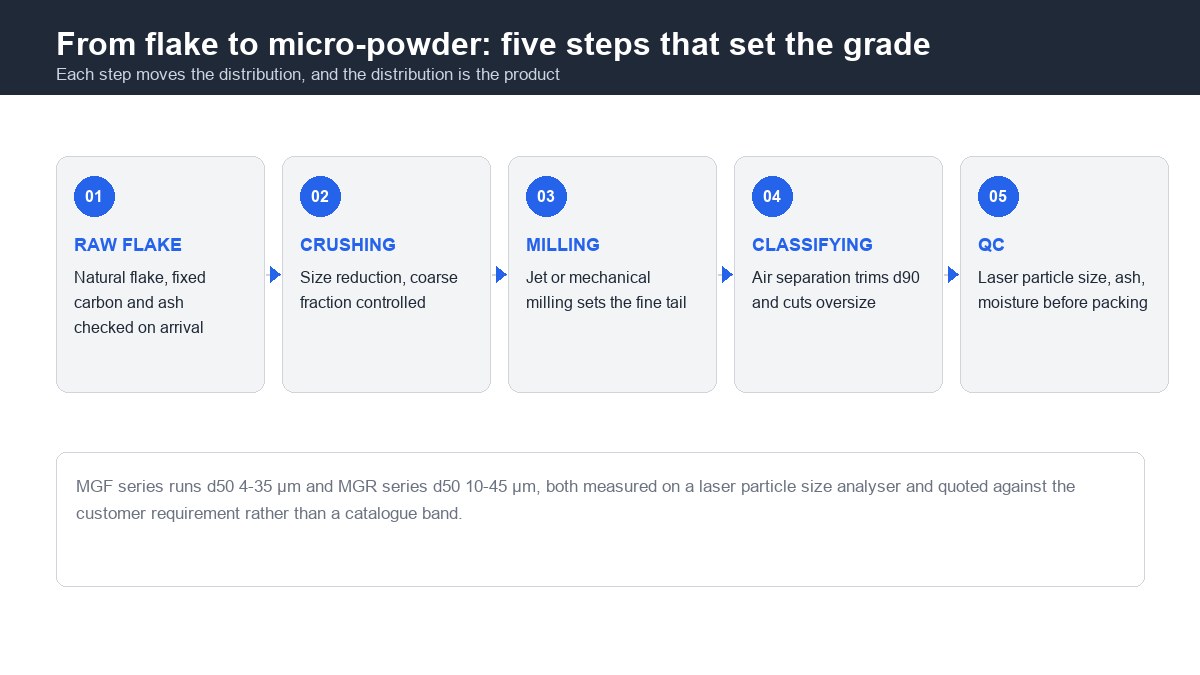
Figure 2. Milling sets the fine tail; classification trims the coarse end.
Milling decides how much fine material is created, and fine material is expensive to remove once it is there. Classification decides how much of the coarse end survives. A supplier who classifies aggressively delivers a tight curve at a higher yield cost; one who does not delivers a wider curve at a lower price. Neither is wrong, but the difference shows up in your process, not on the invoice.
Micro-powder is more sensitive to handling than flake, and the fields that go wrong in transit are not the ones buyers watch. A short incoming routine catches most of it:
The COA reading guide goes through the certificate fields in order, and most of it applies unchanged to a micro-powder certificate.
No. Micro-powder is a dry powder quoted by particle size in microns. Colloidal graphite is a dispersion of fine graphite in a liquid carrier, and it is specified by concentration, carrier and stability rather than by d50 alone. The two can start from the same fine fraction, but they are bought and tested differently.
No. Finer powder forms a thinner, more uniform film, which helps in some contacts and hurts in others where load carrying matters. Below a certain size the film may not survive the contact pressure at all. The right size is set by the contact, the load and the carrier, not by a preference for fine.
There is no single figure. Brush grades balance conductivity, ash and the fine fraction against the duty cycle and the commutator or slip ring they run on. We quote the carbon range and the distribution together and let the brush maker match the pair to the application, rather than publishing one headline number.
Because d50 is one point on a curve. Different milling and classification produce different D10 and D90 around the same midpoint, and different ash and moisture. Ask for the full curve and the test method before comparing prices.
If you are sourcing micro-powder for a specific process, send three things first: your working d50 range, the non-carbon fraction you can tolerate, and how the powder will be fed. We will quote a grade from the micro-powder range against those constraints, with the D10, d50 and D90 from a single laser run and the ash and moisture on the same certificate.
For the purchasing side, the purchase specification guide shows how to write those fields into a document a supplier can be held to.
Prepared by Qingdao XingHe Graphite Co., Ltd. Technical note, November 2026. Size ranges and carbon ranges quoted refer to our standard MGF and MGR series; individual lots are supplied against an agreed data sheet, not against this note.
Online Message
Leading the Graphite Industry with Innovation and Expertise.
Ma GeZhuang Graphite Mine, Pingdu, QingDao, China
Copyright © 2026 QingDao XingHe Graphite Co.,Ltd. All Rights Reserved.