E-mail: John@xhgraphite.com
WhatsApp: +86-18663987730
E-mail: John@xhgraphite.com
WhatsApp: +86-18663987730

News
Colloidal graphite is a stable dispersion of natural graphite particles - typically below 2 microns - in water or an organic carrier. In a dried coating it forms a connected carbon network that dissipates static charge, provides grounding paths and shields electronic assemblies, at a lower density and higher service temperature than metal fillers. Conductivity is not fixed by the graphite grade alone: particle size, solids loading, dry film thickness, binder chemistry and curing all shift the final sheet resistance.
Conductivity in a graphite coating comes from a percolation network of contacting flakes, not from any single property of the powder.
Inside each flake, carbon atoms are arranged in hexagonal layers through which electrons move readily. Between flakes, current crosses physical contact points and thin binder gaps. Once the graphite loading passes a threshold - the percolation threshold - those contacts form a continuous path and resistance drops sharply. Below that threshold the film remains essentially insulating, however conductive the individual flakes are.
Compared with silver, copper or nickel fillers, graphite offers lower density, corrosion resistance, high-temperature stability and a much lower cost per kilogram. Its volume resistivity is higher than that of metals, so it is best used for anti-static dissipation, grounding and EMI shielding rather than for high-current conductors.
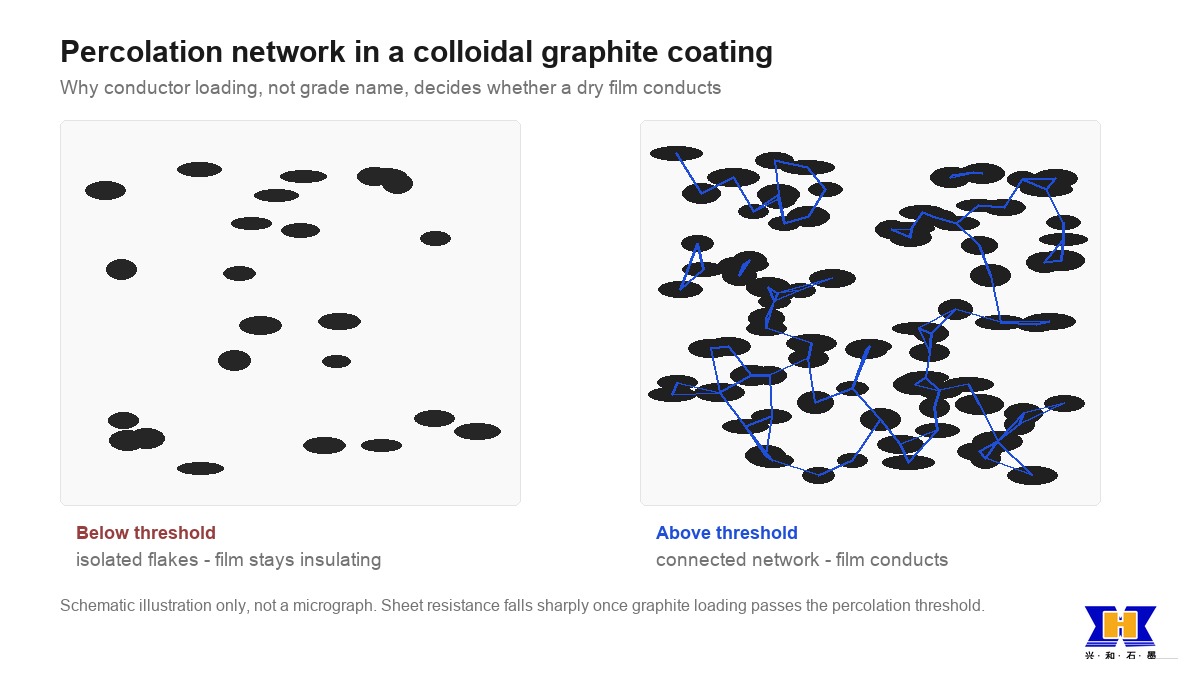
For a given formulation, sheet resistance is driven mainly by dry film thickness, graphite solids content and particle size distribution - not by the grade name on the bag.
| Parameter | Effect on conductivity | What to specify |
|---|---|---|
| Dry film thickness | Thicker films add parallel conductive paths; resistance falls as thickness rises | A single brush pass at about 10 microns may give roughly 800 ohm/sq, while a 25 micron build-up is often below 200 ohm/sq |
| Graphite solids | Must exceed the percolation threshold; below it the coating insulates | Percentage solids and fixed carbon on the COA, measured per batch |
| Particle size (D50) | Fine particles give smoother films and better adhesion but need higher loading; coarser flakes build networks faster | Colloidal grades are typically below 2 microns; match D50 to wet film thickness |
| Binder | Organic binders insulate between flakes; low-binder and thermally cured systems conduct better | Binder type and cure schedule; thermal curing compacts the carbon matrix |
| Substrate | Porous or rough surfaces absorb binder and can starve the network | Primer or sealing where the substrate is absorbent |
Published figures differ between products and are not a unified industry standard. One commercial conductive graphite coating lists 1,000-2,000 ohm surface resistance with 1-10 micron particles; another lists below 2,400 ohm/sq at 25 micron dry film. Always verify sheet resistance on your own substrate, film thickness and cure schedule before approving a specification.
Choose water-based systems for low VOC and for porous or heat-sensitive substrates; choose solvent-based systems when fast drying and adhesion to metal or glass matter more.
| Aspect | Water-based | Solvent-based |
|---|---|---|
| Carrier | Water with dispersants | Organic solvent such as IPA or ethanol |
| VOC | Low | High |
| Drying | Slower, humidity-sensitive | Fast |
| Best substrates | Paper, plastics, textiles, porous ceramics | Metals, glass, dense ceramics |
| Typical uses | Anti-static packaging, heat-sensitive parts | EMI shielding, electrode coatings, high-temperature release |
| Watch-outs | Wetting, freeze-thaw stability, alkaline pH (one commercial product lists pH 10-14) | Flammability, ventilation, solvent recovery |
Colloidal graphite coatings appear wherever a surface needs to conduct or dissipate charge without a metal layer:
Anti-static packaging, flooring and conveyor components
EMI shielding for enclosures and cable assemblies
Electrode and current-collector coatings in batteries and fuel cells
Conductive layers on glass, ceramics and polymer films
High-temperature release and dry-film lubricant coatings
Sensor electrodes and test fixtures
Our colloidal graphite grades are produced from natural flake graphite and are available as F-1 and F-2 dispersions. Buyers who need a dry powder instead can review micro-powder graphite with controlled D50. For pigment and coating uses outside electronics, the chemical industry application page summarizes the role of graphite in paints, inks and corrosion-resistant coatings.
Fixed carbon and solids - ask for both values on the certificate of analysis, not only a grade name.
D50 and particle size distribution - request a laser particle size report per batch.
Carrier and VOC - confirm the solvent system meets your line environmental and safety permits.
Viscosity and thixotropy - check whether the product suits spraying, brushing or dip coating.
Batch consistency - compare sheet resistance across at least three lots on your own substrate.
Packaging and settling - confirm drum size, shelf life and the recommended redispersion procedure.
Two reference guides help here: how to read a natural flake graphite COA, and our graphite purchase specification guide.
Typically hundreds of ohms per square at 10-25 microns dry film. Published commercial values range from about 200 to 2,400 ohm/sq depending on product and cure. Lower resistance requires higher solids, thicker films, thermal curing or hybrid metal fillers.
Only where very high conductivity is not required. Silver inks reach the milliohm range; graphite coatings are suited to anti-static, grounding and EMI shielding. In high-current or high-frequency circuits, graphite is normally a cost-reduction component used alongside metal fillers.
Graphite itself is stable at high temperature; the binder sets the practical ceiling. One commercial product lists 204 C continuous service, and binder-free or inorganic systems go higher.
Keep containers sealed, avoid freezing, and stir or roll before use because graphite settles. Check the stated shelf life - one commercial product lists at least two months from shipping under the original seal.
Match D50 to the wet film thickness. Below about 2 microns suits smooth, thin films; coarser flakes build conductive networks faster in thicker coatings.
Three points decide whether a colloidal graphite coating performs as specified: the carbon and solids data on the COA, a controlled D50, and a cure schedule verified on your own substrate. Specify all three in writing, and check sheet resistance per batch rather than per grade name.
Online Message
Leading the Graphite Industry with Innovation and Expertise.
Ma GeZhuang Graphite Mine, Pingdu, QingDao, China
Copyright © 2026 QingDao XingHe Graphite Co.,Ltd. All Rights Reserved.