E-mail: John@xhgraphite.com
WhatsApp: +86-18663987730
E-mail: John@xhgraphite.com
WhatsApp: +86-18663987730

News
Pencil lead is often treated as the purest grade of graphite on the market. It is not. Pencil grade is a balancing act between four things that pull in different directions: flake shape, what sits inside the ash, how the particle size is distributed, and how much sulphur and moisture the powder carries. Two suppliers can both ship "pencil grade" and behave completely differently on the same core line.
This guide is written for people who buy graphite for pencil cores, and for the technicians who have to make someone else's purchase decision work. It covers what graphite actually does inside a core, which four fields decide whether the powder is usable, and how to check a delivery before it reaches the mixer.
The dark material in a pencil is a fired mixture of graphite, clay and a binder, later impregnated with wax or oil. Graphite carries the colour and the glide; clay carries the hardness and the strength. The ratio between them is what turns a soft 6B into a hard 4H, and the same graphite can sit in either end of that range depending on how much clay surrounds it.
This matters commercially. A buyer who compares graphite as a standalone commodity, on carbon content and price alone, is optimising a variable that the core recipe will partly overwrite. What the recipe cannot fix is a powder whose flakes do not orient, whose ash contains hard grit, or whose tail of coarse particles keeps scoring the paper no matter how the clay is adjusted.
Four jobs, and each of them depends on flake structure rather than on carbon percentage alone.
Colour. Flake graphite lays down flat against the paper. A flake that orients leaves a continuous dark layer; a stubby or fragmented particle scatters light at its edges and reads lighter even at the same carbon content. This is why two powders with identical assay can produce visibly different blackness.
Glide. Graphite shears between its layers. The lower the friction along the sheet plane, the smoother the stroke and the less the writer feels the paper tooth. Flake shape and the proportion of fine particles both feed into this.
Conductivity. Electrochemical pencils and electrolytic marking rely on a conductive path through the core. Graphite supplies it; clay interrupts it. Grade choice therefore changes how a marking pencil behaves on an anodised or coated surface.
Green strength and firing behaviour. During extrusion and firing, graphite affects how the core densifies and how it releases moisture. Too fine a powder demands more binder and shrinks more; too coarse a powder leaves weak planes that fail as breakage.
Ash is usually reported as a single percentage, and that single number hides the thing that matters. The question is not how much ash there is, but what the ash is made of.
Quartz and other silicates are far harder than graphite on the Mohs scale, in the range of seven against one to two. A particle of quartz sitting in a core is a cutting edge dragging across the paper. A tenth of a percent of the wrong mineral does more damage than half a percent of a soft one.
Iron behaves differently: it shifts colour toward a colder, greyer tone, and in a moist core it can show as speckling after storage. Alkali-bearing minerals act as fluxes during firing and change how the core densifies, which shows up as hardness drift between batches.
A practical consequence: a higher fixed carbon grade with coarse grit can write worse than a slightly lower carbon grade that was properly de-sanded. Ask for ash and a breakdown of the ash, at least iron and silica, and treat a COA that reports only "ash: x%" as incomplete. Our note on reading a natural flake graphite COA explains which lines are worth insisting on.
Pencil people talk in mesh, and mesh is a screening convention, not a size. Two lots that both pass a 200 mesh screen can hold very different amounts of material near the cut point, and that is what the writer feels.
Coarse particles are grit. Anything retained on the fine screen behaves like sand in the core: it scores the paper, it wears the die, and at the tip it creates the small hard spot that turns into a chip. Very fine particles fail in the other direction. They need more binder, they lower green strength, and they force the recipe to add more graphite to reach the same blackness, which then softens the core beyond the target hardness band.
Distribution width matters as much as the median. A narrow curve lets a core recipe stay put across deliveries. A wide curve with a long coarse tail forces the line to re-tune clay every time a new lot arrives, and the re-tuning shows up as hardness scatter in the finished pencil.
When you specify, do not stop at D50. Ask for the screen residue on the fine cut, and for D90 and D99 from laser diffraction. If the supplier only quotes a median, the tail is unmanaged. The field list in our purchase specification guide covers the same point from the buying side.
Pencil grade is one of the few graphite applications that genuinely prefers large flakes, and the reason is orientation. A flake that lies parallel to the paper presents its basal plane to the page: high coverage, low friction, good blackness. The same property helps in extrusion, where flakes align along the flow and give the core a direction.
Pure coarse flake is not the answer either. Large flakes pack poorly, mix unevenly with clay, and leave weak planes between aligned sheets, which is exactly where a core snaps. In practice pencil powders are blends: a coarse flake fraction for blackness and glide, a fine fraction to fill, bind and smooth the extrusion. Our +100 mesh flake grade is the coarse end of that blend; the natural flake series covers the cuts below it. The blend ratio moves with the hardness band being produced, and it is one of the few places where a supplier's grading discipline is visible in the product.
This is also why mesh alone cannot describe pencil grade. Two powders at the same nominal mesh can differ in flake thickness and in the ratio of intact flakes to broken fragments. A microscopic look at flake diameter against thickness tells you more about how the powder will write than any screen number.
These two are the quiet fields. Neither appears in a sales sheet, and both generate complaints.
Sulphur shows up as odour in the mixing room and in the finished pencil, and it reacts with metal parts such as ferrules and clips. In a closed workshop the smell is the first thing operators notice, long before anyone measures performance. Sulphur also liberates during firing, which puts it into the atmosphere of the kiln rather than into the product.
Moisture affects weighing accuracy, mixing uniformity, extrusion density and the way powder cakes in storage. A powder that gained moisture in a humid warehouse will not reproduce the recipe that was validated in the dry season. Both fields are cheap to test and expensive to discover late.
Four steps stand between a flake concentrate and a pencil-grade powder, and the order matters.
Air-jet or ball milling sets the top size and decides how much flake survives intact. Impact-heavy milling breaks flakes into fragments, which costs blackness later. A gentle circuit that cuts rather than shatters preserves the aspect ratio the pencil needs.
This is where pencil grade is won or lost. Milling finer does not remove grit; it concentrates it, because the sand fraction does not shrink at the same rate as the graphite. Multi-stage classification, gravity separation and magnetic treatment are the tools, and the result has to be verified on the screen residue rather than assumed from the process.
A narrow cut is a commercial promise as much as a technical one. It is what allows a pencil plant to keep one recipe across several deliveries instead of re-validating clay ratios every quarter.
Coarse and fine fractions are recombined to a target, and the blend is what a pencil buyer actually receives. Fineness and cleanliness are separate properties; improving one does not improve the other, and a specification that names only fineness leaves cleanliness unmanaged.
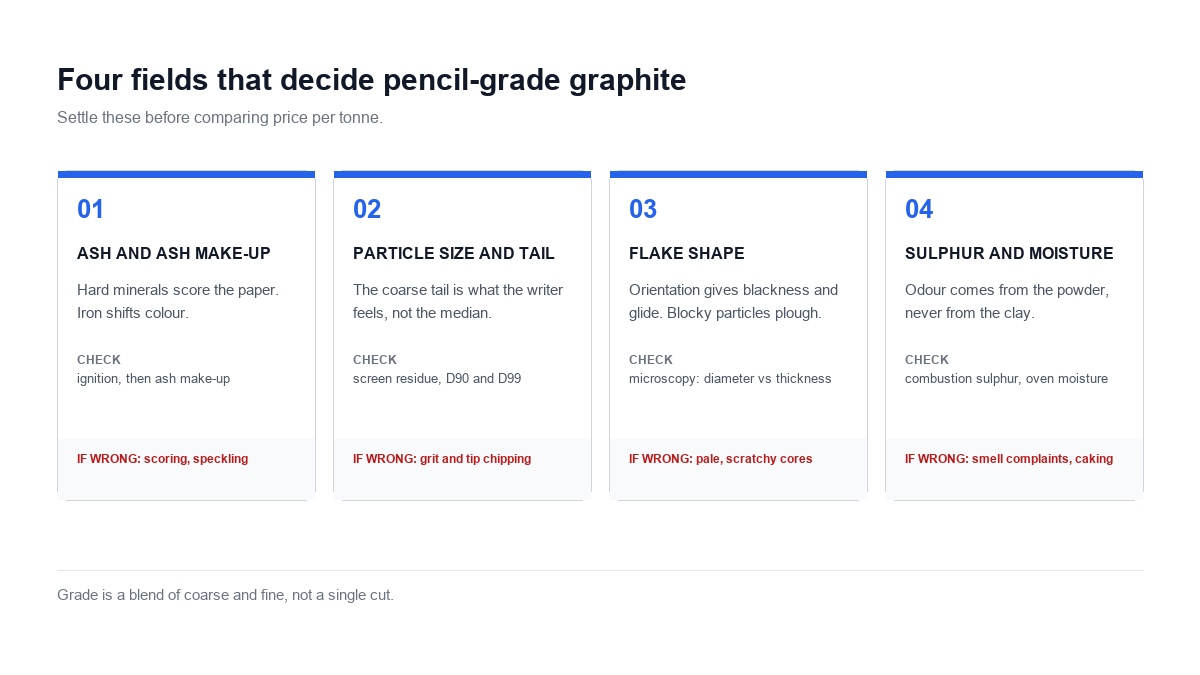
Figure 1. The four fields that decide whether a powder can be called pencil grade. Price comparison comes after these, not before.
A pencil plant does not need a laboratory to protect itself. It needs five checks and a sampling rule that makes them meaningful.
Sample from at least three positions in the bag or the ton bag, and from more than one bag in a delivery. Graphite segregates in handling: the fines settle and the coarse fraction rises, so a sample taken from the top surface describes the bag, not the batch.
| Check | Why it matters in a pencil core | How to verify | What goes wrong if skipped |
|---|---|---|---|
| Ash and ash make-up | Hard minerals score the paper; iron shifts colour | Ignition and weighing, plus a breakdown of the ash | Scoring, speckling, hardness drift |
| Screen residue on the fine cut | The coarse tail is what the writer feels | Wet or dry screening at the agreed cut | Grit, tip chipping, die wear |
| Size distribution, D90 and D99 | A long tail destabilises the recipe | Laser diffraction, same dispersion routine each lot | Hardness scatter between batches |
| Flake shape | Orientation gives blackness and glide | Microscopy: flake diameter against thickness | Pale, scratchy, brittle cores |
| Sulphur and moisture | Odour complaints and core strength | Combustion or coulometric sulphur, oven drying | Smell in the workshop, caking, weak cores |
Scoring the paper. Almost always grit, not chemistry. Check the screen residue before touching the clay ratio.
Breaking at the tip. Usually too fine a powder pushed too hard, or flake alignment creating weak planes. Both are visible in the powder, none of them in the COA.
Reading pale. Either ash is high, or graphite has been under-dosed to hold hardness, or the flakes are fragmented enough to scatter light instead of covering the page.
Feeling scratchy without grit. A shape problem. Thick, blocky particles do not shear; they plough. No amount of wax fixes a powder that never learned to lie flat.
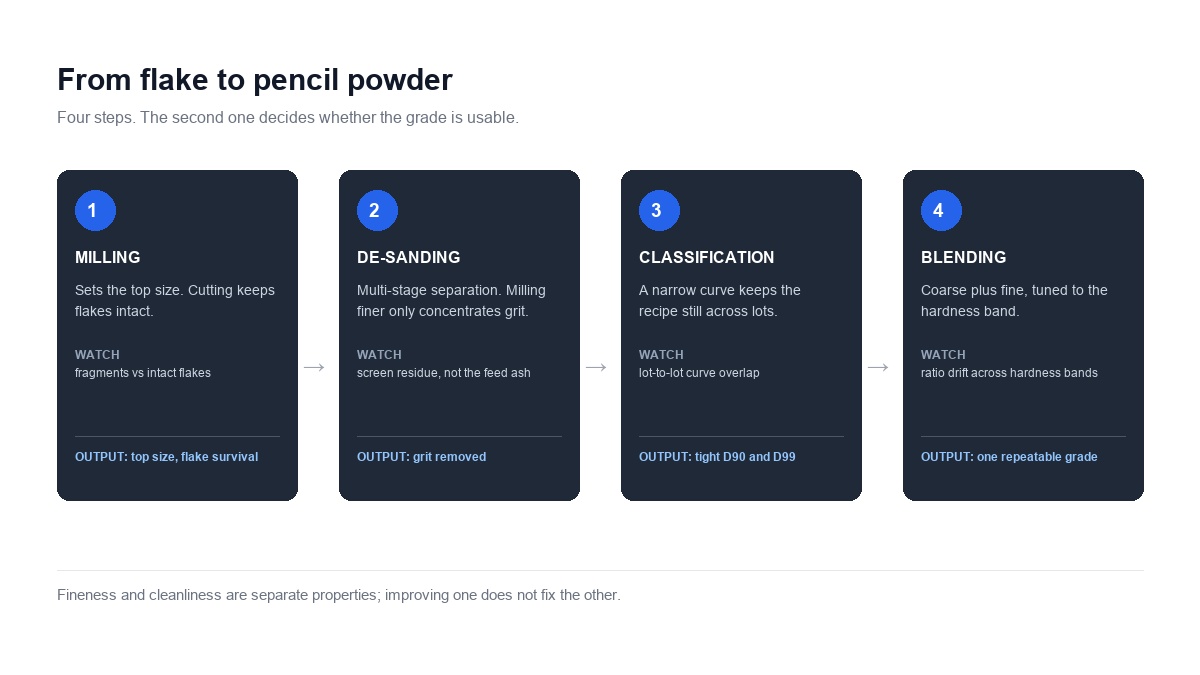
Figure 2. Four steps from flake concentrate to pencil powder. De-sanding is the step that decides whether the grade is usable.
Is higher fixed carbon always better for pencil grade? No. Above the level the core needs, extra carbon buys nothing if the ash carries hard minerals or the tail is coarse. A slightly lower carbon grade that is clean and narrow will usually write better than a high-carbon powder with grit.
Can synthetic or artificial graphite replace natural flake in a core? It can be used, and some cores blend them, but the economics and the flake behaviour differ. Natural flake gives the aspect ratio that produces coverage and glide at lower cost; synthetic material is generally used where a specific electrical or purity requirement justifies it.
Why do two powders at the same mesh write differently? Because mesh is a cut-off, not a description. The tail, the flake thickness and the amount of broken fragments all vary under the same nominal mesh, and all three change how the powder covers paper and how it extrudes.
Is a larger flake always better? Only up to the point where the blend still mixes and extrudes cleanly. Pure coarse flake leaves weak planes and packs badly. Pencil grade is a blend by design, not a single cut.
If you are qualifying graphite for pencil cores, send three things with your enquiry: the hardness band you produce, the blackness target you are judged on, and the graphite-to-clay ratio in your current recipe. That is enough to match a grade instead of guessing at a mesh number. Our high carbon flake grades list pencil leads as a standard application, and the micro powder line covers the fine fraction. For a grade proposal, use the contact form.
Note: figures and limits in this article are given as selection logic, not as specifications. Actual values are those stated in the supplier's TDS and in the COA of the delivered lot. Particle size figures refer to laser diffraction unless a screening method is named.
Online Message
Leading the Graphite Industry with Innovation and Expertise.
Ma GeZhuang Graphite Mine, Pingdu, QingDao, China
Copyright © 2026 QingDao XingHe Graphite Co.,Ltd. All Rights Reserved.