E-mail: John@xhgraphite.com
WhatsApp: +86-18663987730
E-mail: John@xhgraphite.com
WhatsApp: +86-18663987730

News
Graphite is not a filler in a carbon brush. It is the phase that carries current, the phase that keeps the commutator film alive, and the phase that stops the brush from eating the copper. Get the balance wrong and the brush sparks, wears fast, or runs hot — usually all three together.
This note covers what to settle before a grade is quoted: which brush family you are in, what d50 and the tail behind it do to mixing and wear, where carbon content actually costs money, and the five checks worth running when the lot arrives. Numbers here are ranges, not promises for a single batch; a brush grade is quoted against your drawing and your data sheet, not against a catalogue band.
A carbon brush has three jobs at once, and graphite is involved in all three.
It conducts. Graphite is the conductive skeleton of the brush. Current passes through the graphite network, and the resistivity of that network sets how much heat the brush carries at a given current density.
It lubricates. Graphite is a solid lubricant. It lowers friction against the commutator or slip ring and, more importantly, it feeds the film that forms on the copper surface.
It builds the film. The dark patina on a healthy commutator is not dirt — it is a mixed layer of copper oxide, graphite and moisture that carries current across the contact without metal-to-metal contact. A brush that cannot maintain that film runs rough and wears the copper.
These three pull against each other. More graphite means better lubrication and a more stable film, but higher resistivity and lower mechanical strength once the binder is diluted. More binder or more coke means a stronger, harder brush that machines well, but it wears the copper faster and generates more dust. That trade-off, not the carbon content alone, is what a brush grade is.
The same graphite powder behaves differently depending on what it is mixed with and how the brush is cured. The family decides the priority order.
Graphite mixed with a carbonaceous binder, pressed and cured at moderate temperature. The graphite content sits in the middle of the range and the binder does the structural work. Here the graphite is chosen for film formation and running smoothness; too coarse a powder shows up as uneven contact and noise rather than as wear.
The formed brush is taken to graphitising temperature, so the binder itself converts toward graphite. Purity and consistency matter more here than raw conductivity: ash left in the body becomes an abrasive that shortens brush life. This is the family where high-carbon, low-ash natural flake pays for itself.
Copper or silver powder is added to cut resistivity. Used where voltage is low and current is high — starters, battery forklifts, some DC traction. The graphite is no longer the main conductor, but it is still the lubricant, so its share and its particle size have to be matched to the metal powder rather than optimised on their own.
High-speed motors, sealed motors, and applications where the brush cannot deposit a normal film. The requirement shifts from "conduct and lubricate" to "survive": thermal stability, low dust, and a powder that will not segregate in a sealed housing.
The d50 of a graphite powder tells you where the middle of the distribution sits. It is the number that governs mixing behaviour and pressed density: finer powder covers the binder better and gives a more uniform green body; coarser powder leaves the mix open and presses to a lower density.
But d50 alone does not describe what the brush will feel at the contact. A grade with a good d50 and a long coarse tail puts individual large flakes at the rubbing surface, and those flakes behave like small cutters — visible as streaking on the commutator and as higher brush wear. That is why a brush discussion should always carry D10, d50 and D90 from the same measurement, not a single midpoint.
Our micro-powder series run d50 from 4 to 35 µm (MGF) and 10 to 45 µm (MGR), measured on a laser particle size analyser, with a dedicated series for carbon brushes. Those are the ends of the range, not a claim that any point in between behaves the same; the grade you buy is the band you confirm on the data sheet.
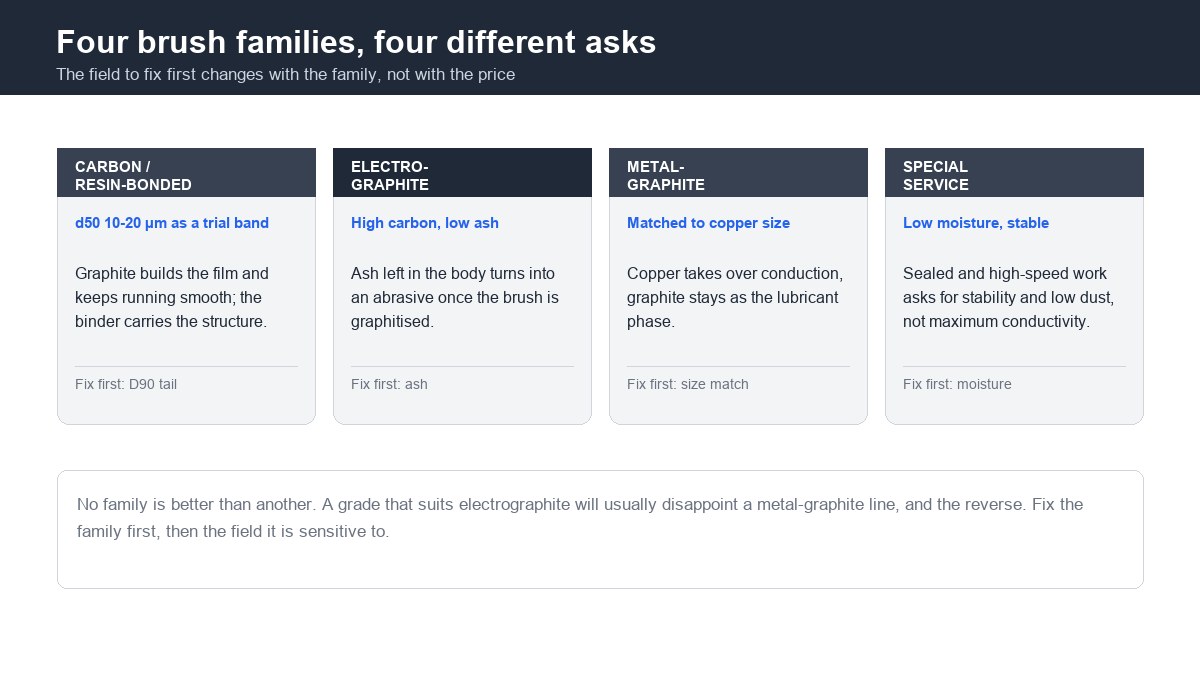
Figure 1. Each brush family places the graphite in a different role, so the first field to fix changes with the family.
Carbon content is the field buyers ask about first and understand last. The difference between 90 % and 99.99 % is not "more graphite instead of less" in a way that directly improves a brush; it is how much non-graphitic material comes with it.
That residue — ash — does two things inside a brush. It raises resistivity in a way that is hard to predict batch to batch, and at graphitising temperature it can leave abrasive particles in the body. A brush made from a high-ash grade often fails in a way that looks like a design problem: uneven wear, hot spots, dust that will not stay in the film.
Natural flake graphite carries an advantage here beyond purity: the flakes are anisotropic, so pressing tends to align them, and that alignment helps both conductivity and film formation in the finished brush. It also means the grade has to be specified by its flake size, because the same carbon content at two different flake sizes will not press or wear the same.
Adding copper powder lowers resistivity sharply and lets a brush carry high current at low voltage without overheating. The cost is paid on the lubrication side: every percent of copper is a percent less graphite in the rubbing face, and the film becomes harder to maintain.
Two things decide whether a metal-graphite program runs well. First, the metal and graphite powders have to be matched in size — a fine copper powder with a coarse graphite will segregate during mixing and press unevenly. Second, the graphite's own ash and moisture have to be low, because in a metal-graphite body there is no graphitising step to clean things up; what goes in is what the brush keeps.
A brush line is sensitive to changes that a general graphite buyer would never notice. Five checks catch most of them before they reach the mixer.
A brush specification that lists only carbon content and d50 will be quoted by everyone and matched by no one. The table below is the order we recommend: fix the family, then the field that family is actually sensitive to, then the checks that prove it on arrival.
| Brush family | What the graphite is doing | Field to fix first | Common mismatch |
|---|---|---|---|
| Carbon / resin-bonded | Film formation, smooth running | d50 and D90 | Coarse tail shows as noise and streaking |
| Electrographite | Conductivity plus low abrasion | Ash at high carbon content | High ash leaves abrasive in the body |
| Metal-graphite | Lubricant alongside the metal phase | Size match to the metal powder | Segregation during mixing |
| Special-service | Stability, low dust | Moisture and thermal history | Powder segregates in a sealed housing |
Table 1. The field that matters first changes with the brush family; the arrival checks stay the same.
Two documents decide whether a brush program stays stable. The first is the incoming COA, which should carry the method next to each result — carbon by combustion, ash by the same standard, size by laser. The second is your own record of the last three lots, because a grade only drifts in a way you can see when you have a line to compare against.
If a lot does not match, the useful question is not "is it out of spec" but "which curve moved". A carbon drop with an unchanged size curve points at the raw material. A flat carbon with a lengthened coarse tail points at classification. Moisture drifting alone usually means storage, not the mill.
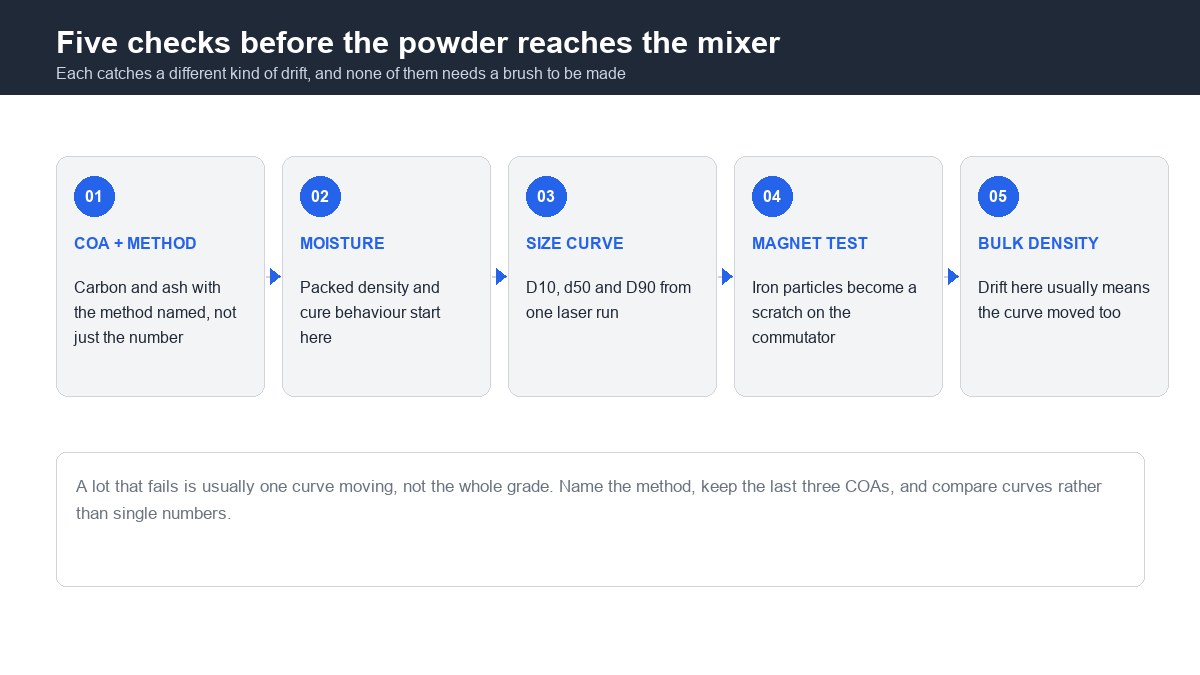
Figure 2. Five checks that catch drift before the powder reaches the mixer; none of them needs a finished brush.
Is higher carbon content always better for brushes?
No. Above a certain point, extra purity buys little in a carbon-bonded brush and costs a lot per tonne. What matters is ash and consistency: a stable 95 % grade beats a drifting 99 % grade on a brush line.
Does finer graphite reduce brush wear?
Only up to a point. Finer powder improves film uniformity, but a very fine grade can lower pressed strength and increase dust. The useful move is to cut the coarse tail rather than to push d50 down.
Can one grade serve electrographite and metal-graphite?
Rarely. Electrographite rewards low ash and a controlled flake size; metal-graphite rewards a powder matched to the copper or silver particle size. Buying one grade for both usually compromises one line.
Where should a new brush program start on d50?
Start from the family and the contact speed, then pick a band and test it, rather than copying a catalogue number. If you have no reference, the 10–20 µm band is the usual first trial for carbon and electrographite work.
If you are specifying a brush grade, send the drawing, the contact speed, the current density and the last COA you accepted. We will come back with a band, the checks that matter for your family, and a sample plan — see the micro-powder graphite series for the range, or write to us through the contact page.
Related reading: what d50, purity and ash decide in micro-powder, mesh size versus particle size distribution, how to read a graphite COA, and how to write a purchase specification.
Technical note by Qingdao XingHe Graphite Co., Ltd. (青岛兴和石墨), Qingdao, China. Published 2026-11-20. Ranges quoted are series limits; each lot is supplied against the data sheet agreed with the buyer.
Online Message
Leading the Graphite Industry with Innovation and Expertise.
Ma GeZhuang Graphite Mine, Pingdu, QingDao, China
Copyright © 2026 QingDao XingHe Graphite Co.,Ltd. All Rights Reserved.