E-mail: John@xhgraphite.com
WhatsApp: +86-18663987730
E-mail: John@xhgraphite.com
WhatsApp: +86-18663987730

News
Korea imports essentially all of the natural graphite its plants consume. There is no domestic flake production to fall back on, so every tonne used in a refractory mix, a brake pad, an anode line or an insulation board arrives by ship and passes through a specification before it enters the plant.
That makes the Korean market unusually clear about what it wants from a supplier. The buyer is not asking whether you have a mine. The buyer is asking whether the material in the next container will read the same as the material in the last one, against a COA they have already qualified. Repeatability, not headline numbers, is the product.
This page sets out which graphite grade goes to which Korean demand pool, which field decides the purchase in each case, what the import file has to contain, and how the shipment is checked on arrival. It is written for purchasing, technical and quality staff on the Korean side who already know their process and need to match it to a grade.
Korean graphite consumption concentrates in five areas, and each one judges a lot by a different field. A supplier who quotes a single carbon figure for all five will lose four of them.
| Demand pool | What is bought | Field to fix first | How it fails |
|---|---|---|---|
| Refractory and foundry | +100 to +200 mesh flake, medium and high carbon | Carbon fixed and ash make-up | Ash minerals react with slag; lining life drops |
| Friction | High-carbon flake, controlled D50 | D50 and ash, then volatiles | Fade, noise, rotor scoring |
| Li-ion anode | Spherical graphite (SPG) | D50, purity, tap density, coating | Low first-cycle efficiency, gassing, swelling |
| Flame retardant and sealing | Expandable graphite, +32 to +100 mesh | Expansion volume and onset temperature | Weak char, dripping, gasket leakage |
| Lubrication and coatings | Micro-powder and colloidal graphite | D50, carrier, solids content | Settling in the drum, nozzle clogging |
Korean purchasing and technical documents usually carry the English grade name alongside a Korean term. Matching the two early saves a round of samples. The pairs that come up most often are below.
| English | Korean | What it decides in the plant |
|---|---|---|
| Natural flake graphite | 천연 박편 흑연 | Base grade for refractories, friction, lubricants |
| High-carbon graphite | 고탄소 흑연 | Friction and conductive applications |
| High-purity graphite | 고순도 흑연 | Anode feedstock, speciality parts |
| Spherical graphite | 구상 흑연 | Anode material |
| Expandable graphite | 팽창 흑연 | Flame retardant, gaskets, sorbents |
| Refractory / foundry | 내화물 / 주물 | Bricks, monolithics, mould washes |
| Friction material | 마찰재 | Brake pads, discs, clutches |
| Anode material | 음극재 | Lithium-ion cell negative electrode |
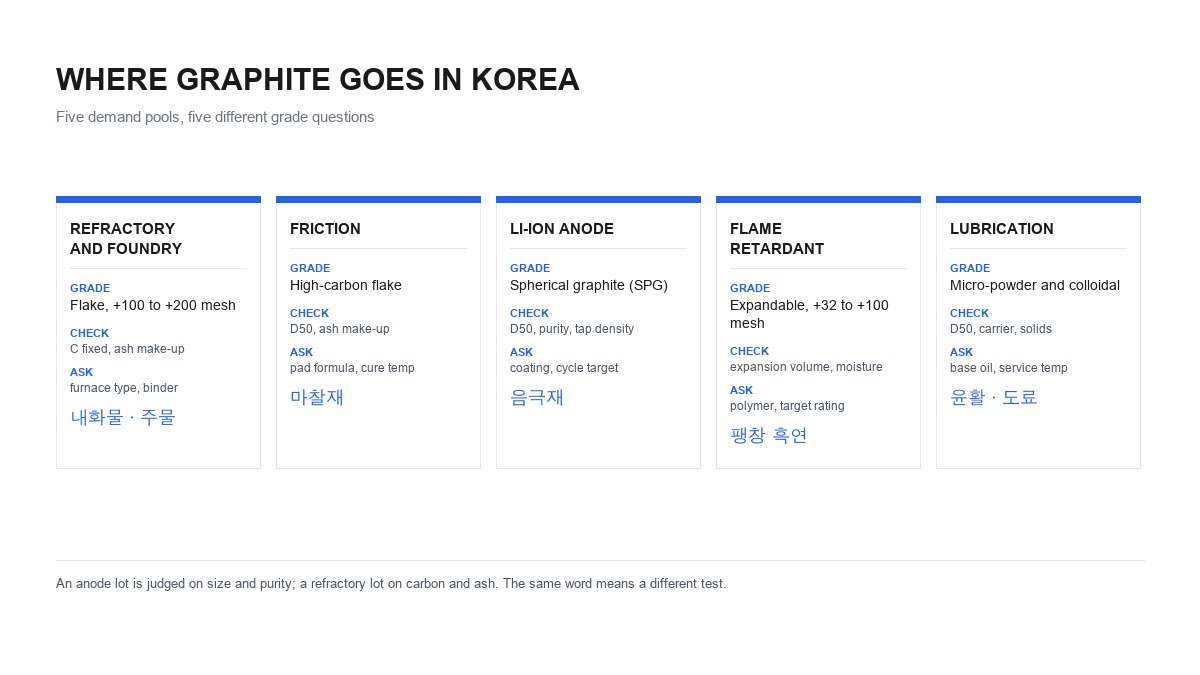
Figure 1. The same word covers five different tests in Korea. An anode lot is judged on size and purity; a refractory lot on carbon and ash.
Korean steel, cement and glass plants buy graphite flake as a carbon source and as a thermal shock buffer in bricks, ramming mixes, gunning mixes and mould washes. The purchase almost always turns on two fields: carbon fixed and the make-up of the ash, not the ash percentage alone.
A 95% carbon flake with iron-rich ash behaves worse in a slag-exposed lining than a 90% carbon flake with clean ash. When a Korean buyer sends a specification, the ash analysis is usually attached for exactly this reason. If your COA only reports total ash, you will be asked for the breakdown on the second email.
The mesh cut matters as much. +100 and +200 mesh flake is the working range for most shaped and monolithic products, because finer material raises binder demand and coarser material opens porosity. Particle shape is checked visually in most plants: thin, plate-like flakes with a defined length-to-thickness ratio are what a refractory mix is formulated around. A lot that is chunky rather than platy will change the mix rheology even at identical screen analysis.
Our natural flake graphite range covers medium-carbon and high-carbon grades in the +100 to +200 mesh window, and the COA carries carbon, ash, moisture and volatile matter per lot.
In brake pads, discs and clutches, graphite works as a solid lubricant and a heat path at the same time. Korean friction formulators tend to specify a high-carbon flake with a controlled D50 rather than a wide screen cut, because the fine tail of the distribution drives resin demand and the coarse tail drives noise.
Two practical points come up repeatedly in quotation rounds. First, D50 and the top cut should be quoted together; a specification that names only the mesh will be read differently by the lab and by the mixing room. Second, ash in a friction mix is not inert. Abrasive ash raises wear on the counter-face, so the ash make-up is reviewed with the friction modifier package, not in isolation.
Volatile matter is the third field to settle, since it affects curing behaviour and can produce surface defects after the press. For carbon brush applications, where conductivity and ash both matter, a dedicated grade is usually requested rather than a friction grade.
Korea is one of the centres of lithium-ion materials production, and the anode side of that industry buys spherical graphite rather than flake. Two processing routes reach the same product family: natural spherical graphite, where flake is spheroidised, purified and then coated, and synthetic spherical graphite, where coke or needle coke is graphitised, milled and rounded.
An anode buyer reads a very different set of numbers from a refractory buyer. D50 and the full distribution come first, then carbon purity, then tap density, then specific surface area, then the coating. Purity is the field where the two industries stop sharing vocabulary: anode grades start at 99.9% carbon and move up, while a refractory grade at 95% is a premium product.
Coating is the part that cannot be judged from a datasheet alone. Amorphous carbon coating, pitch coating and their variants change first-cycle behaviour and gassing, so most anode evaluations run on a coated sample, not on uncoated powder. If a supplier quotes spherical graphite without stating the coating state, the quotation is incomplete.
We produce spherical graphite in standard and micro-spherical cuts from natural and synthetic feedstock, with high-purity graphite at 99.9% carbon and above as the upstream grade.
Expandable graphite is bought for what it does when heated, not for what it contains cold. Korean buyers in insulation boards, polyurethane foams, cable compounds and gasket sheet specify an expansion volume and an onset temperature first, then moisture, pH and residual sulphur.
The mesh cut sets the application. +32 to +100 mesh is the commercial window, with coarser cuts preferred where a thick, voluminous char layer is wanted and finer cuts used where dispersion in a polymer matters more than expansion height. Residual sulphur and pH are the fields that decide whether the board passes an ageing test, and they are the fields most often missing from a first quotation.
The same material serves sealing. Flexible graphite sheet and gasket makers buy expandable graphite and control the exfoliation themselves; foundries and environmental sorbent suppliers buy it for oil absorption. One grade rarely fits all three, because the expansion profile that suits a gasket is too aggressive for a foam.
Our expandable graphite range runs from +32 to +100 mesh, with expansion volume quoted per lot.
Micro-powder graphite is the grade Korean lubricant blenders, forging shops and coating formulators buy, and the purchase splits into two decisions that are often quoted as one. The powder decision is D50: our micro-powder graphite lines run MGF at 4 to 35 micrometres and MGR at 10 to 45 micrometres, measured by laser particle sizer, with carbon from 90% to 99.99%. The carrier decision is what the powder goes into: water, oil or solvent, and at what solids loading.
For dispersions, colloidal graphite and the graphite emulsion series are specified as ready-to-use products with a stated solids content and a stability requirement, because settling in a drum is the failure that matters most in a plant. A product that passes the lab dispersion test and settles in three weeks in storage is not the same product.
Forging and die-casting lubricants sit between these two families: they want a micro-powder grade that disperses cleanly in a water-based carrier and leaves no residue on the die. Volatile matter and the absence of grit are usually the acceptance fields.
A Korean purchase is not closed when the price is agreed. It is closed when the import file is complete, because the importer cannot clear and the plant cannot release incoming material without it. Six documents carry most of the weight.
1. COA per lot, with the lot number printed on the bag and repeated on the certificate, so the warehouse can match bag to paper.
2. MSDS, in Korean where the plant EHS team has to file it. A Chinese-only MSDS delays the release even when the material is fine.
3. HS classification. Natural graphite sits under HS 2504.10; processed grades are classified with the importer, and the classification should be agreed before the first booking.
4. Certificate of origin, including the China-Korea FTA form where the buyer intends to claim preferential treatment.
5. Packing list, with net and gross weight per pallet, so the receiving team can plan the unload without opening every bag.
6. Chemical compliance input. Whether an import needs registration under the Act on Registration and Evaluation of Chemical Substances depends on tonnage and use, and your importer holds that answer. What a supplier can do is provide composition, MSDS and a substance identity statement so the check closes quickly instead of stalling.
Ports matter for scheduling rather than for price. Korean graphite imports land at Busan, Incheon and Gwangyang, and the choice usually follows the plant location and the forwarder's consolidation. We ship from Qingdao, on FOB Qingdao or CIF Korean port terms, with the sailing fixed at booking rather than quoted as a promise.
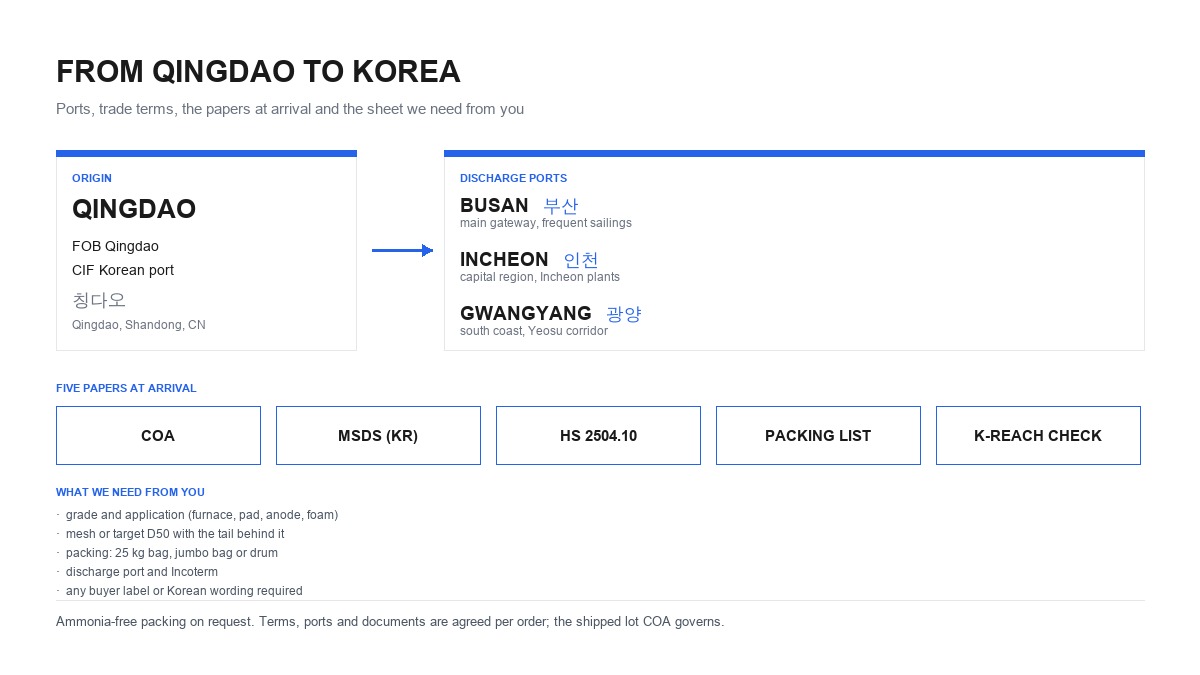
Figure 2. Three arrival ports, six documents, and the five fields we need from a Korean buyer to quote accurately.
Korean plants typically run a short receiving protocol on graphite, and knowing it in advance is the cheapest way to avoid a rejection that has nothing to do with the material.
1. Bag to certificate. Lot number on the bag matched to the COA. A mismatch stops the release before any test starts.
2. Moisture. Sealed-bag moisture against the specification. Graphite that picks up moisture in transit changes binder demand in a refractory mix and can foam in a coating.
3. Size, by the same method. Sieve analysis and laser diffraction do not give interchangeable numbers. A buyer who compares a laser D50 against a sieve residue will see a difference that does not exist.
4. Flake shape, by eye. Plate-like against chunky, at the same screen cut. This is the check that datasheets cannot carry.
5. Packing integrity and label. Bag condition, pallet wrap, and whether the Korean label matches the shipping documents.
Qingdao Xinghe Graphite runs the full chain from natural flake to the processed grades Korean plants buy, which means a buyer can consolidate several lines in one booking instead of splitting an order across three traders.
Natural flake, medium and high carbon, +100 to +200 mesh and finer cuts
High-purity graphite at 99.9% carbon and above
Micro-powder graphite: MGF at 4 to 35 micrometres, MGR at 10 to 45 micrometres
Spherical graphite in standard, micro-spherical and standard-spherical cuts
Expandable graphite, +32 to +100 mesh
Colloidal graphite and graphite emulsion for coatings and release agents
Graphite carburizer, amorphous graphite, artificial granular graphite and graphene
Packing in small paper bags or one-tonne bulk bags, labelled to the buyer's format
If you are still defining the specification, the purchase specification guide sets out the fields that belong on it, and how to read a flake graphite COA covers the certificate side. Both are written for the person who has to defend the number in an internal review.
Do you ship to Busan and Incheon? Yes. We quote FOB Qingdao or CIF Korean port, and the sailing is confirmed at booking.
Which grade fits a brake pad, and which fits a refractory brick? High-carbon flake with a controlled D50 for the pad; +100 to +200 mesh flake with low and clean ash for the brick. They are not interchangeable, even at the same carbon figure.
Can you supply spherical graphite for an anode trial? Yes, in standard and micro-spherical cuts, coated or uncoated as specified. Tell us the D50, purity and coating state you are qualifying.
Is the COA per lot or per shipment? Per lot. The lot number on the certificate is the lot number on the bag.
Can you label in Korean? We print the label from the artwork and text you supply, so the wording stays under your control.
What decides the price more, grade or volume? Grade, in most cases. Purity, ash make-up and the tightness of the D50 window move cost more than a container count.
To quote accurately rather than approximately, we need five things: the application and the process it feeds, the grade or particle size you currently run, the carbon and ash limits on your incoming specification, the annual volume and typical lot size, and the destination port with the Incoterm you work on. With those five, the quotation comes back as a grade recommendation with a lot-based COA sample, not a price list.
Send them through the contact form and note the destination port; enquiries that name a port are routed to the export desk directly.
Online Message
Leading the Graphite Industry with Innovation and Expertise.
Ma GeZhuang Graphite Mine, Pingdu, QingDao, China
Copyright © 2026 QingDao XingHe Graphite Co.,Ltd. All Rights Reserved.