E-mail: John@xhgraphite.com
WhatsApp: +86-18663987730
E-mail: John@xhgraphite.com
WhatsApp: +86-18663987730

News
Specifying expandable graphite for fire protection comes down to three numbers on the datasheet: onset expansion temperature, expansion ratio or expansion volume, and particle size. Get those three aligned with your process temperature and your fire test target, and most grade-selection arguments resolve themselves. The remaining properties — fixed carbon, moisture, pH, residue — decide whether the grade behaves the same way in your plant, batch after batch.
This guide sets out what each of those levers does in a fire, the ranges published by suppliers, where the usual formulation mistakes come from, and the checks to run before you switch grades on an approved product. It is written for compounders, coating formulators and buyers who already know they want an intumescent system and need to pin down the mineral side of it.
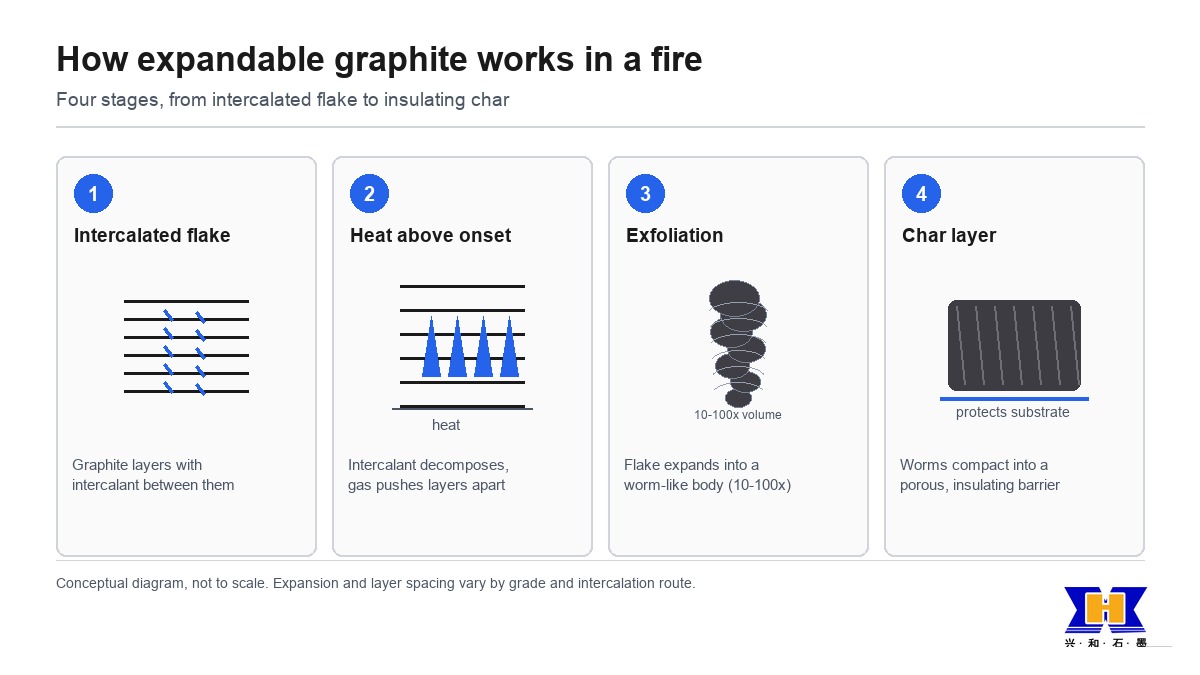
Expandable graphite starts as natural flake graphite in which an intercalant — typically an acid-based compound — has been inserted between the graphene layers, then washed and dried. The flake looks like ordinary graphite powder at room temperature. Above a designed onset temperature the intercalant decomposes, the released gas pushes the layers apart, and a single flake unrolls into a vermicular, worm-like body that can occupy tens to hundreds of times its original volume.
In a fire, that expansion does two things. It physically thickens the material and it builds a porous carbonaceous layer with low thermal conductivity, which slows heat transfer to the substrate and restricts the fuel feeding the flame. This is a physical mechanism, not a halogen-based chemical one — a point worth keeping straight when you compare it with brominated or chlorinated systems.
The table below collects the ranges that major suppliers publish. Read it as a map of the market, not as a standard: every producer sells to its own datasheet, and two grades with the same headline numbers can still behave differently in the same resin.
| Property | Typical range published | What it decides in the formulation |
|---|---|---|
| Onset expansion temperature | 150–220 °C (ROCC); 150–280 °C (NGS); 170 °C (LKAB FireCarb); 220 °C (BariteWorld); most grades 180–300 °C (PranaGraf) | How early the material responds in a fire, and how much headroom you have above your processing temperature |
| Expansion ratio / volume | 150:1–300:1 (ROCC); 20–650 cm³/g (NGS); 250 cc/g (BariteWorld); 275 ml (LKAB TEG-370) | Char thickness and insulating capacity per unit mass |
| Particle size | 50–80 mesh (ROCC); −45 to +500 µm (NGS); 50–270 mesh (BariteWorld); 80% below 300 µm (LKAB) | Dispersion quality versus expansion size; screenability in thin sections |
| Fixed carbon | 90% minimum (ROCC, NGS, LKAB); up to 93%+ (BariteWorld) | Residue after burn-out, ash level, and consistency of the char |
The most common failure is not a bad grade — it is a grade whose onset temperature sits too close to the temperature the compound actually reaches. A 180 °C grade in a process that peaks at 195 °C will partially expand inside the extruder: you lose expansion capacity before the product ever sees a flame, and the surface shows a fine, blistered texture that is easy to mistake for a dispersion problem.
Practical rule: keep the highest melt or cure temperature at least 20–30 °C below the onset temperature of the grade, and confirm that figure on your own equipment rather than on a generic curve. The same logic runs the other way at the fire end. A 280 °C grade in a system that needs to respond in the first minute of a cellulosic fire test is the wrong choice, however good its expansion ratio looks.
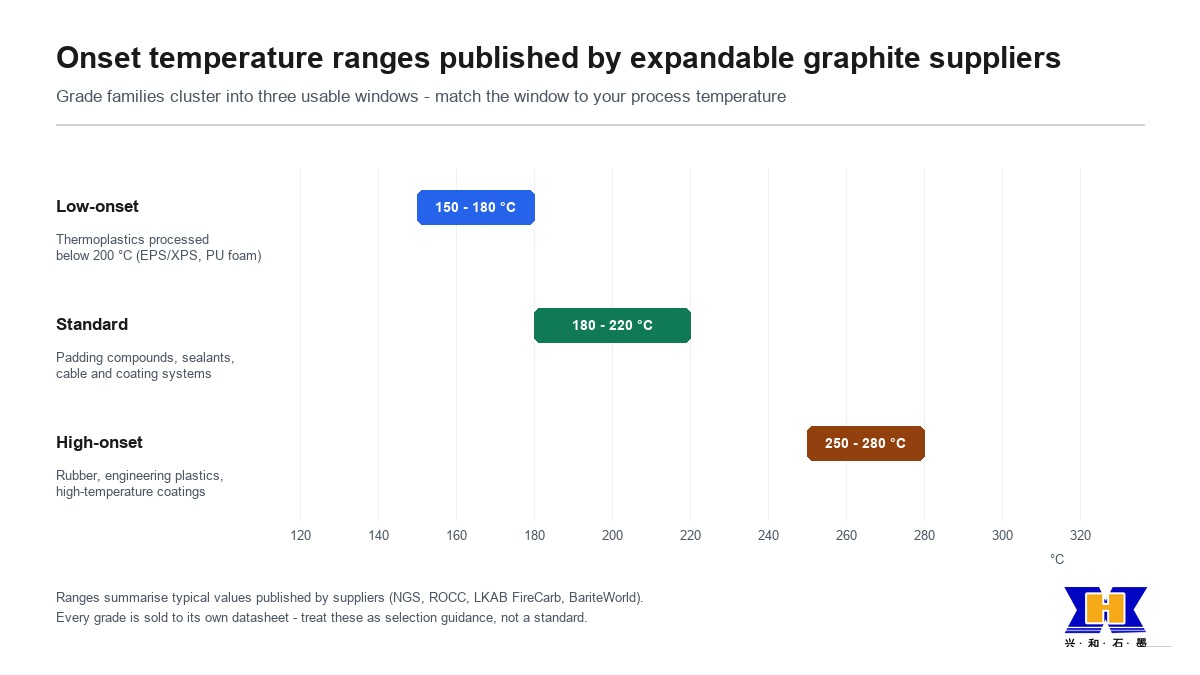
Low-onset grades (roughly 150–180 °C) suit thermoplastic systems processed below about 200 °C, such as EPS and XPS foams and sprayed polyurethane. Standard grades (180–220 °C) cover most sealants, padding compounds and cable compounds. High-onset grades (250–280 °C) are chosen for rubber compounds, engineering plastics and coatings that cure or are applied at elevated temperature. These windows are an industry summary of supplier data, not a classification standard.
Expandable graphite is usually one component of an intumescent system rather than the whole answer. Classic chemical intumescence relies on an acid source, a carbon source and a gas source working together; graphite adds a physical, mineral-based char former that keeps working when the chemical system has already been consumed. Combining the two is common in sealants and coatings, where graphite improves char strength and the chemical system fills the volume around it.
Three practical constraints come with that combination. First, the two systems must share a temperature window — an acid source that starts decomposing below the graphite onset temperature will gas off before the graphite expands. Second, graphite flakes agglomerate easily and need proper wetting; high-shear dispersion helps, but excessive shear can damage the flake structure and cost you expansion. Third, the carrier matters: polar resins wet graphite more readily than non-polar ones, and highly filled systems leave less room for the volume increase that makes the mechanism work.
| Application | Typical matrix | Properties that matter most |
|---|---|---|
| Intumescent seals and penetration seals | Elastomer or thermoplastic profile | Expansion ratio, onset temperature, profile integrity |
| Fire-retardant coatings for steel | Acrylic, epoxy or water-based binder | Particle size, expansion ratio, weathering |
| Rigid polyurethane and foam insulation | PU foam, phenolic foam | Low onset temperature, dispersion, low moisture |
| Halogen-free cable compounds | EVA / PE with ATH or MDH | Coarse fraction, synergy with mineral fillers |
| Fire boards and thermal barriers | Composite or inorganic binder | Expansion volume, char layer cohesion |
A certificate of analysis that lists only carbon content is not enough for a fire application. When you qualify a new grade or a new source, ask for and check the following:
Expansion test conditions. Expansion ratio means little without the test method: heating rate, final temperature, whether the sample expanded freely or in a constrained crucible. Two suppliers can quote 250:1 from two different methods.
Onset temperature by instrument. A TGA or DSC curve is more informative than a single number, because it shows the shape of the release, not only where it begins.
Moisture and pH. Residual moisture and acidity both affect shelf life in a compound and corrosion risk on the steel or aluminium behind a coating.
Sieve fraction. The coarse and fine ends matter differently: coarse particles give larger worms but are harder to disperse, fines disperse well but contribute less volume.
Consistency across lots. Fire performance is usually a pass/fail test on a finished product, so a grade that shifts between lots turns every re-qualification into a full test programme. Our purchasing specification guide sets out how to write the acceptance clauses; the COA reading guide covers the fields that should be on the certificate.
The graphite itself contains no halogen and works by physical expansion, which is why it is grouped with halogen-free fire protection options. The finished product still has to pass the relevant fire standard as a system — the additive alone does not confer a classification.
No. APP works through a chemical intumescent cycle; graphite works by physical exfoliation. Replacing one with the other changes the char formation mechanism, and most formulators use them together rather than swapping them.
Start from the thickness of the finished part and your dispersion equipment. Thin coatings and sealants usually favour finer grades for surface quality; thicker profiles can carry coarser grades and benefit from the larger expansion they produce. 50–80 mesh (about 180–300 µm) is a common starting point for general profiles.
Only if the compound exceeds the onset temperature. Keep 20–30 °C of headroom and verify the real melt temperature at the die, not the setpoint on the controller — shear heating often adds more than expected.
Not necessarily. Expansion has to be delivered at the right time and the resulting char has to stay in place. A very high ratio in a weak char can fail earlier than a moderate ratio in a coherent layer, which is why qualification belongs on the finished assembly.
Two earlier articles on this site cover the application side of expandable graphite: expandable graphite in fire-resistant coatings and flame-retardant applications and grade selection. This guide deliberately stays on the specification numbers and the process-temperature constraint, because that is where most formulation failures actually start.
Our expandable graphite range is produced from natural flake graphite and sold against a datasheet that states onset temperature, expansion volume, mesh and carbon content for each grade. If you are matching a grade to an existing formulation, send us the process temperature profile and the fire test you need to pass, and we will shortlist the grades that sit inside those limits rather than the ones with the biggest headline number.
For the wider picture of where graphite sits across industries, see our application fields overview.
Sources: ROCC Global, “Expandable Graphite” product data (carbon 90%, expansion 150:1–300:1, onset 150–220 °C, 50–80 mesh), roccglobal.com/products/expandable-graphite; NGS / graphit.de, “Expandable Graphite” technical data (carbon ≥90%, 20–650 cm³/g, onset 150–280 °C, −45 to +500 µm), graphit.de/en/graphite-info/expandable-graphite/; LKAB Minerals, FireCarb product data (onset 170 °C, carbon ≥90%, TEG-370 expansion 275 ml, 80% below 300 µm), lkabminerals.com/product/firecarb/; BariteWorld, expandable graphite data (carbon up to 93%+, 250 cc/g, 50–270 mesh, onset 220 °C), bariteworld.com/graphite/expandable-graphite/; PranaGraf, CarboFlameX (most grades expand 180–300 °C, halogen-free), expandable-graphite.com. All values are supplier-typical and grade-dependent; they are not a unified standard.
Online Message
Leading the Graphite Industry with Innovation and Expertise.
Ma GeZhuang Graphite Mine, Pingdu, QingDao, China
Copyright © 2026 QingDao XingHe Graphite Co.,Ltd. All Rights Reserved.