E-mail: John@xhgraphite.com
WhatsApp: +86-18663987730
E-mail: John@xhgraphite.com
WhatsApp: +86-18663987730

News
From 23 October 2026, firefighting foams containing PFAS at or above 1 mg/L for the sum of all PFAS can no longer be placed on the EU market in portable fire extinguishers. The same date switches on the use conditions and labelling duties for PFAS-containing foams elsewhere in the chain. The full marketing and use ban under the new REACH entry follows on 23 October 2030. The rule is set out in Commission Regulation (EU) 2025/1988, which added entry 82 to Annex XVII of the REACH Regulation.
For suppliers of fire protection materials the direct effect is narrow — this entry covers firefighting foam, not solid intumescent products. The signal it sends is wider: the EU is now regulating fluorinated chemistry out of fire applications step by step, and every formulator working on fire performance is being pushed toward fluorine-free and halogen-free systems.
| Date | Obligation | Who it falls on |
|---|---|---|
| 23 October 2026 | PFAS foam at ≥1 mg/L (sum of all PFAS) may no longer be placed on the market in portable extinguishers | Producers, importers, distributors |
| 23 October 2026 | Use conditions apply: only class B fires, emissions minimised, separate collection of unused stock and PFAS waste, and a site-specific foam management plan | Users of PFAS-containing foam |
| 23 October 2026 | Labelling requirement for foam and for stored stock and waste above the concentration limit | Suppliers and users |
| 23 April 2027 | End of the derogation for alcohol-resistant foam in portable extinguishers; end of the derogation for training and testing and for public fire services | Suppliers and fire services |
| 23 October 2030 | General ban on placing on the market and use of PFAS in firefighting foams; review of the fluorine-free cleaning derogation | All actors in scope |
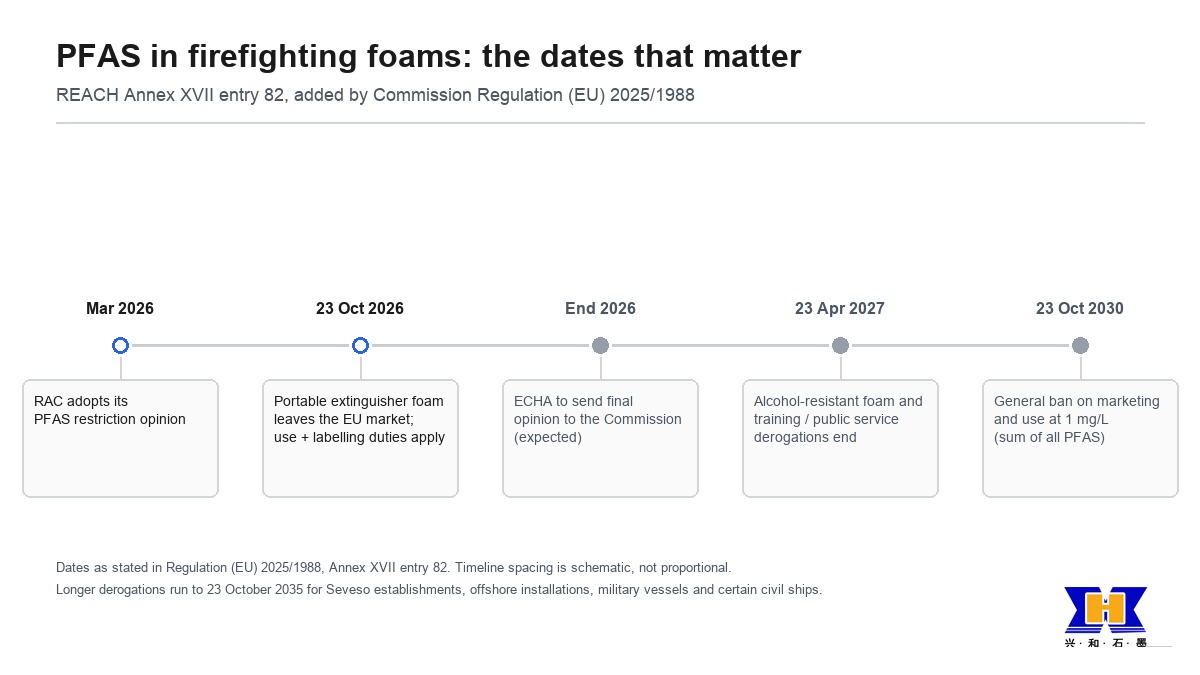
Longer derogations remain for specific sites — establishments covered by the Seveso Directive, offshore oil and gas installations, military vessels and certain civil ships run to 23 October 2035 — which is why the practical replacement cycle in heavy industry will trail the headline date by several years.
This entry is one strand of a larger restriction proposal. ECHA's Committee for Risk Assessment (RAC) adopted its opinion on the broad PFAS restriction in early March 2026, and the Committee for Socio-Economic Analysis (SEAC) agreed its draft opinion shortly afterwards. A European Parliament research briefing states that ECHA is expected to transmit its final opinion to the European Commission by the end of 2026, after which the Commission drafts the restriction and Parliament scrutinises it.
Separate tracks are already live. Since January 2026, EU Member States must monitor PFAS in drinking water against adopted limits, and the Industrial Emissions Directive adds reporting obligations for PFOA and PFHxS from 2028. In other words, the direction of travel is fixed even where individual dates are still open.
It is worth being precise here, because the shortcut version of this story is wrong. Expandable graphite is not a drop-in replacement for PFAS firefighting foam. Foam suppresses liquid fuel fires by forming a film and cooling the surface; expandable graphite is a solid additive that forms an insulating char inside a polymer or coating. The two sit in different product categories and are tested against different standards.
What they share is the regulatory pressure on fluorinated and halogenated chemistry. Every substitution decision in a fire application now has to answer the same question: can the performance be delivered without a persistent fluorinated compound? That is pushing formulators to look again at mineral-based and physical mechanisms — intumescent graphite among them — particularly in sealants, coatings, foams and cable compounds where a char-forming layer does the work.
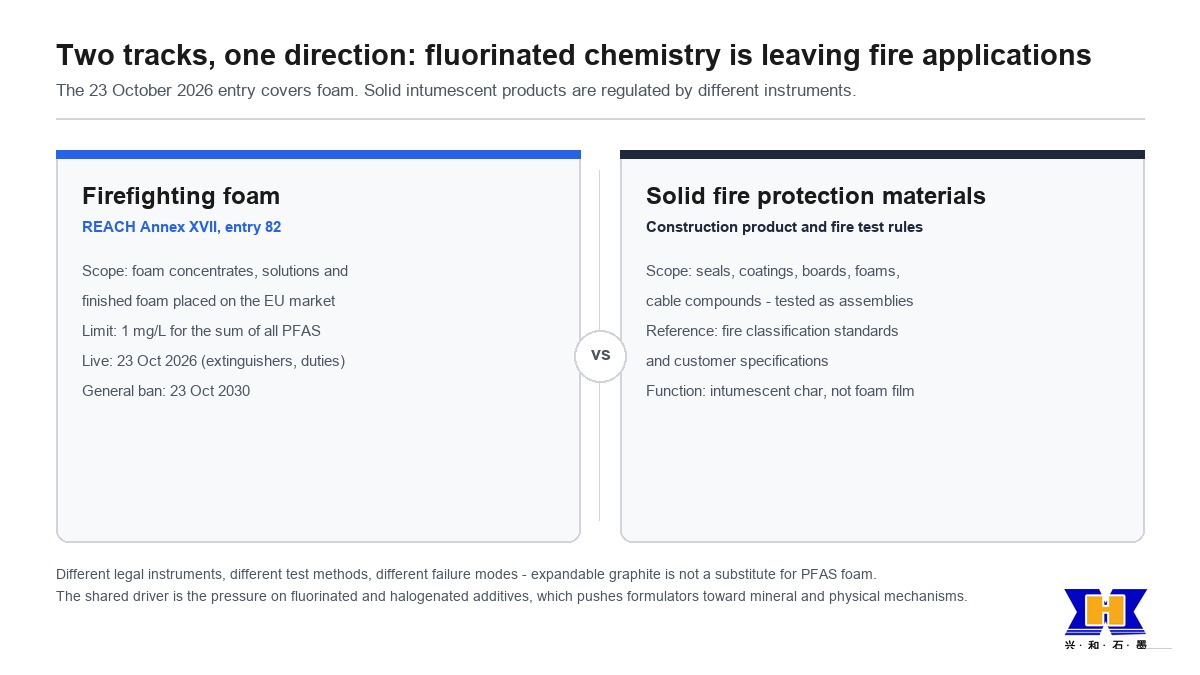
Map the rule to your own product, not to the headline. The 23 October date applies to foam in portable extinguishers. A coating, seal or board is out of scope of that paragraph — but it may fall under construction product fire classification rules or customer specifications that reference the same chemistry concerns. Confirm which instrument actually governs your SKU before reacting to a date.
Do not treat a substitution as a like-for-like swap.
Replacing a flame retardant changes char formation, smoke behaviour, mechanical properties and processing window. Any switch needs re-testing on the finished assembly against the standard your customer cites, not only a datasheet comparison.
Ask suppliers for the data behind the claim. Expansion ratio, onset temperature and purity should come with test conditions attached. Where a supplier cannot state the method behind a number, that number cannot support a regulatory or qualification argument. Our purchasing specification guide sets out the clauses worth putting into an order.
Demand for expandable graphite in fire protection has been growing independently of the PFAS file, driven by construction fire requirements and by the move away from halogenated additives. The PFAS timetable reinforces that trend rather than creating it. For buyers, the practical consequence is less about a sudden spike and more about qualification lead time: the grades that pass a fire test are few, and switching source late in a project is expensive.
Our expandable graphite grades are specified by onset temperature, expansion volume, mesh and carbon content, so a formulation team can match a grade to its process window before committing to a test programme. For the technical side of that selection — how onset temperature and expansion ratio interact — see our guide to specifying expandable graphite for intumescent systems, and the application fields overview for the wider map.
Sources: Commission Regulation (EU) 2025/1988 of 8 October 2025 amending Annex XVII to Regulation (EC) No 1907/2006 as regards PFAS in firefighting foams, entry 82 (EUR-Lex, CELEX 32025R1988); ECHA Committee for Risk Assessment, opinion on the Annex XV dossier proposing restrictions on PFAS, document dated 2 March 2026 (chem.echa.europa.eu); European Parliamentary Research Service, “Per- and polyfluoroalkyl substances: Tackling ‘forever’ chemical pollution”, 2026 briefing (europarl.europa.eu); European Commission, PFAS pollution page, updated November 2026 (environment.ec.europa.eu). Event dates are those stated in the legal text and the cited documents; this article was published on 12 November 2026.
Online Message
Leading the Graphite Industry with Innovation and Expertise.
Ma GeZhuang Graphite Mine, Pingdu, QingDao, China
Copyright © 2026 QingDao XingHe Graphite Co.,Ltd. All Rights Reserved.