E-mail: John@xhgraphite.com
WhatsApp: +86-18663987730
E-mail: John@xhgraphite.com
WhatsApp: +86-18663987730

News
Global pig iron production reached 1.02 billion tonnes in January-September 2026, down 2.2% year on year, according to World Steel Association data reported by GMK Center on 26 October 2026. Blast furnaces produced 929.56 million tonnes, while direct-reduction plants contributed 91.15 million tonnes.
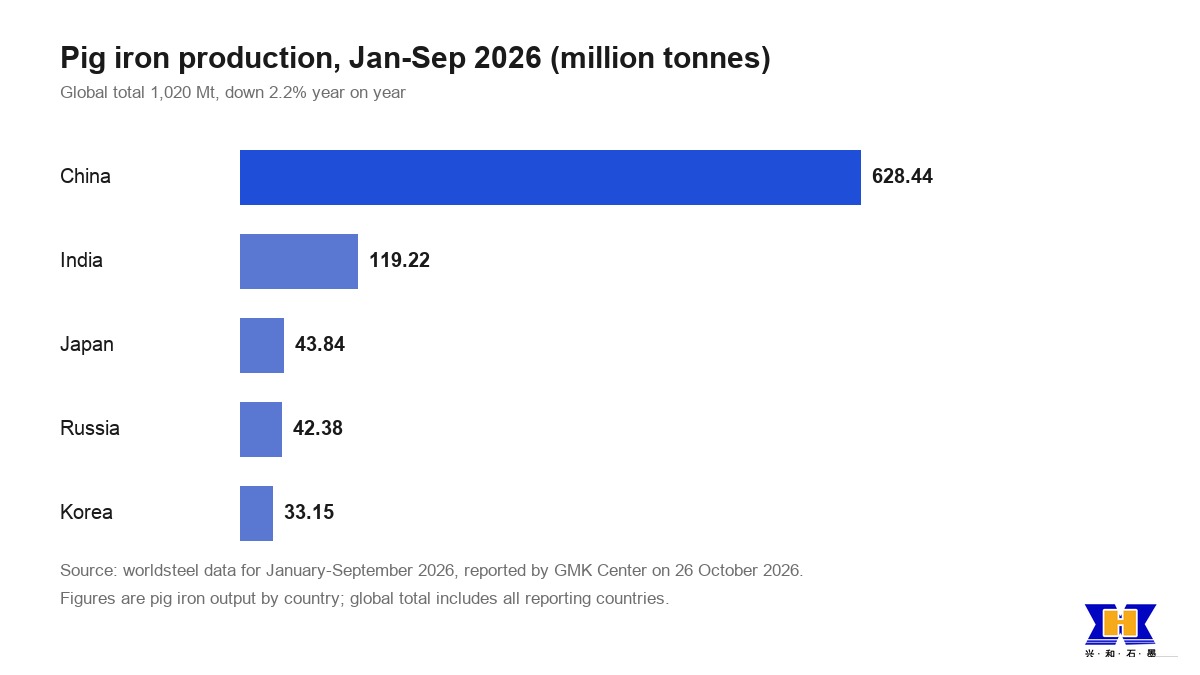
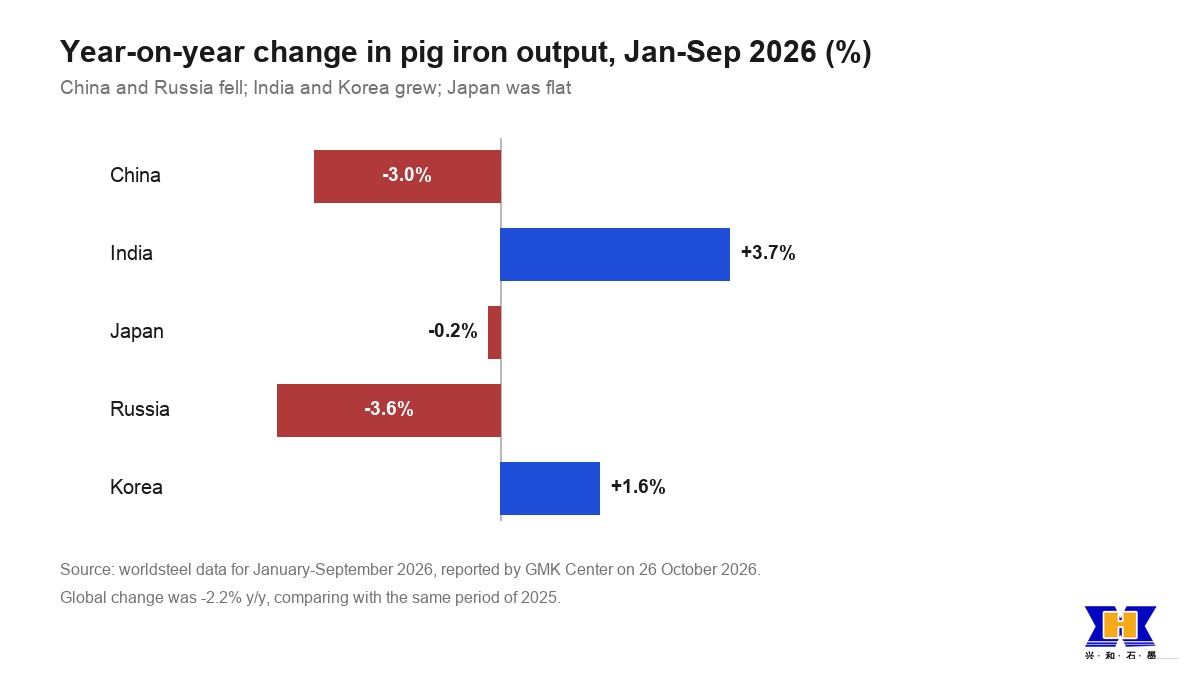
The decline is uneven by region. China produced 628.44 million tonnes, down 3% year on year, while India reached 119.22 million tonnes, up 3.7%. Japan produced 43.84 million tonnes (-0.2%), Russia 42.38 million tonnes (-3.6%) and South Korea 33.15 million tonnes (+1.6%). Global steel production over the same period was 1.37 billion tonnes, down 0.7%.
Pig iron is a primary charge material in gray and ductile iron foundries, and it shapes demand for graphite used in foundry coatings, graphite carburizer additions and other foundry applications of graphite. Lower blast-furnace output in China and Russia points to softer demand for these consumables in those markets, while growth in India and South Korea partly offsets the decline. Graphite demand does not disappear when pig iron falls; it shifts by region and by process route.
The refractory side shows a similar pattern. Refractory applications such as MgO-C bricks, ladle linings and continuous-casting consumables all use natural flake graphite, and their consumption tracks hot-metal and steel output. A 2.2% fall in pig iron output implies a correspondingly softer pull on graphite for blast furnace and ladle refractories, concentrated in the regions that reduced output.
There is also a structural offset. Electric-arc-furnace steelmaking continues to gain share - worldsteel reporting countries produced 30.3% of crude steel in electric furnaces in 2025, according to Mordor Intelligence - which supports graphite electrode demand even as blast-furnace pig iron declines. The net effect for graphite is a mix shift rather than a uniform contraction.
For purchasing teams, the practical reading is regional rather than global. Buyers sourcing from Chinese producers should expect continued pressure on volumes into traditional blast-furnace-linked applications, and should confirm delivery schedules and lot consistency early. Buyers serving Indian or Korean foundries face tighter competition for consistent flake grades. Either way, a specification that fixes carbon content, flake size distribution and ash/sulphur limits remains the most reliable protection against substitution risk.
Source note: Production figures are from World Steel Association data as reported by GMK Center on 26 October 2026 (https://gmk.center/en/news/global-pig-iron-production-fell-by-2-2-y-y-in-january-september/), covering January-September 2026. The electric-furnace share figure is from Mordor Intelligence's Graphite Electrode Market report published 22 October 2026. This article was prepared on 7 November 2026. Figures are third-party industry data, not company forecasts.
Online Message
Leading the Graphite Industry with Innovation and Expertise.
Ma GeZhuang Graphite Mine, Pingdu, QingDao, China
Copyright © 2026 QingDao XingHe Graphite Co.,Ltd. All Rights Reserved.