E-mail: John@xhgraphite.com
WhatsApp: +86-18663987730
E-mail: John@xhgraphite.com
WhatsApp: +86-18663987730

News
Anode material is the one graphite product where a single purity figure tells you almost nothing. Two spherical graphite powders can both read 99.9% carbon and behave differently in the same cell, because four other numbers move independently of purity: the particle size distribution, the tap density, the specific surface area, and the state of the coating.
This is the part that costs buyers time. A supplier quotes carbon content, the buyer compares carbon content, and the qualification line then discovers that the powder presses to a different density or gasses more than the incumbent lot did. The specification was not wrong. It was incomplete.
What follows is how those numbers relate to each other, which ones a supplier can hold from lot to lot, and what belongs on an incoming specification before the first drum is opened.
Spherical graphite reaches an anode line by two processing routes, and buyers usually know which one they are qualifying even when the quotation does not say so.
Natural route. High-carbon natural flake is milled and shaped into rounded particles, then purified at high temperature. The flake grade going in sets the ceiling on what purification can reach, which is why anode-grade natural flake is bought against carbon and ash rather than against mesh alone.
Synthetic route. Coke or needle coke is graphitised, then milled and rounded. The graphitisation step fixes the crystal structure before shaping begins, so the process controls differ, but the purchase fields at the end are the same four.
Both routes end in a coated powder, and both are sold by D50 band. In practice the two are distinguished at qualification, not at purchase order, and a supplier that runs both should say which one it is quoting.
Spherical graphite is graded by D50, and a grade name such as D50-8 is a statement about where the middle of the distribution sits. That single number is the least informative part of the specification, because two powders centred on the same D50 can have very different tails.
The fine end drives surface area and binder demand; the coarse end drives coating uniformity and, in a pressed electrode, the risk of local contact loss. So an anode specification that names only D50 leaves the buyer comparing a median against a distribution. d10 and the top cut belong next to D50 on the same line, and a supplier who can quote them per lot is telling you the classifier is under control.
One practical caution: laser diffraction is the method the industry uses, and results are method-dependent. Comparing a supplier's d10 against your own historical sieve data produces a gap that is instrumental, not real. Fix the method in the specification before fixing the numbers.
Anode grades start at 99.9% carbon and move up from there, which puts them in a different category from refractory or friction grades where 95% is already premium. The number itself is easy to quote. The composition behind it is what separates two suppliers at the same figure.
A tenth of a percent of ash is a thousand parts per million of something, and the something matters. Iron, silicon and sulphur behave differently in a cell, in a coating furnace, and in a slurry. A certificate that reports total ash only tells the buyer that there is 0.1% of an unknown mixture. For anode qualification, the ash breakdown belongs on the certificate, and it belongs there per lot rather than per grade.
This is also where the upstream flake decision shows up. Purification removes what the process can reach; it does not remove what the feed makes expensive to reach. Natural flake bought at a higher carbon and a cleaner ash profile produces a more stable purified output than flake bought on mesh alone and purified harder.
Tap density is the field that links the powder to the electrode. A rounded particle packs better than an angular one of the same size, which is the whole reason flake is spheroidised at all. But tap density measured in a graduated cylinder and press density reached on a calender are not the same quantity, and an electrode target is usually expressed in the second.
Coating changes this field more than any of the other three. A coating layer adds mass without adding packing volume, so a coated powder reads a lower tap density than its uncoated precursor at the same size. That is not a defect; it is arithmetic. The mistake is to compare a coated grade against an uncoated one on tap density alone and conclude that one of them is denser material.
For a buyer, the useful form of the question is: at our loading and our calendering, what press density does this lot reach, and how much does it vary lot to lot? A supplier who answers that has the process under control. A supplier who quotes a single tap density number and stops has answered a different question.
Surface area is the field that decides first-cycle behaviour, and it is the one buyers most often leave off the specification until a problem appears. A finer powder has more surface for the same mass, consumes more lithium in forming the passivation layer, and holds more moisture. All three show up as first-cycle efficiency loss or as gassing during formation.
Spheroidising raises surface area by design, because rounding a flake means breaking it into many small particles, and the fines fraction carries most of the surface. Purification then removes ash from that surface, and coating covers part of it. The number a buyer should hold is the BET value of the coated product, not of the precursor, because that is the surface the electrolyte actually sees.
This is also why a lot can pass purity and fail the cell. The certificate reads 99.9% and the surface area sits at the top of the band, and the formation step consumes more lithium than the model allowed for.
Coating is usually named on a quotation as a word: coated, or amorphous-carbon coated, or pitch coated. That word covers a range of processes with different masses and different uniformity, and it is the field most often left vague.
Amorphous carbon coating deposits a disordered carbon layer that buffers the surface against direct electrolyte contact. Pitch coating sinters a layer that is partly graphitic and improves conductivity at the particle contact. Both raise cycle stability and both reduce the surface the electrolyte can attack, and both add mass that must be accounted for in the capacity calculation.
What a buyer should ask for is the coating mass fraction and a statement on uniformity, plus a BET reading on the coated product. Without those three, a coated grade is a description rather than a specification, and two suppliers can both say coated while delivering powders that behave like different products.
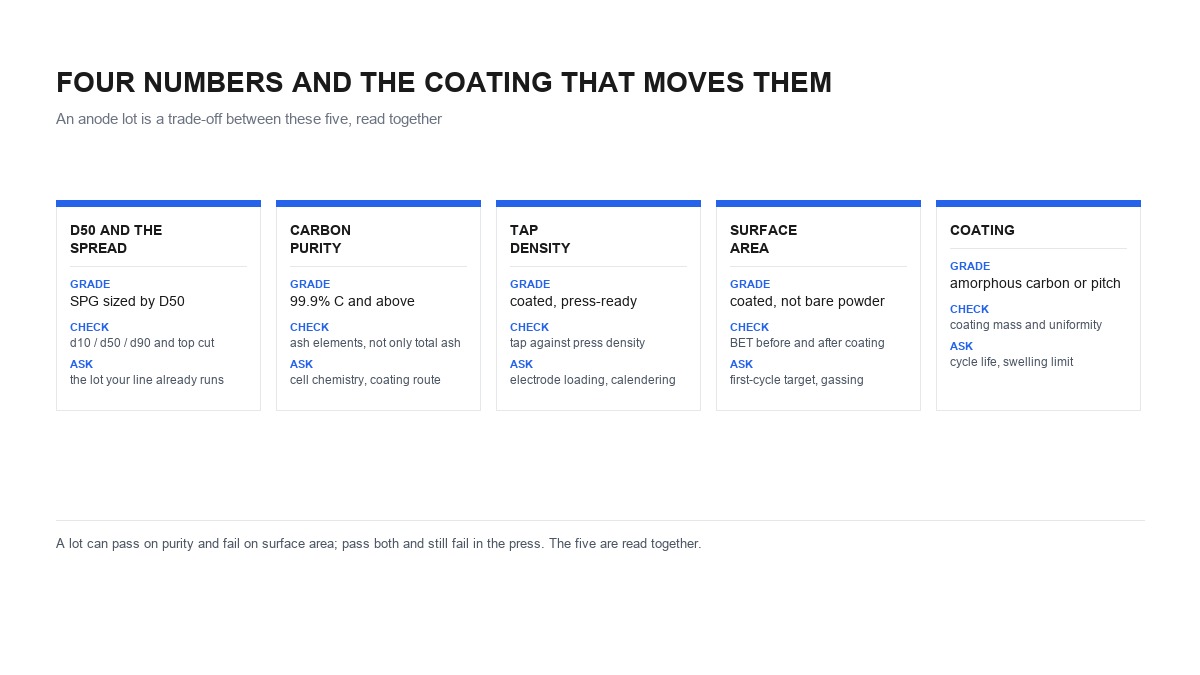
Figure 1. The four numbers are read together, and the coating moves all four. Purity alone is the least useful of the five.
Understanding where each number is set helps a buyer read a quotation and helps a supplier explain a deviation. The chain runs in five steps, and every one of them moves a field on the certificate.
1. Feed selection. Flake is bought against carbon and ash. This step sets the ceiling on final purity.
2. Spheroidising. Milling and rounding fix particle shape and produce the fines fraction. Surface area rises here, and yield is decided here.
3. Purification. A high-temperature step removes residual ash. This is where 99.9% and above is reached, and where the ash breakdown on the certificate is settled.
4. Classification. Cut points produce the D50 band and the d10 and top cut that sit around it. Classification is what a supplier controls when a buyer asks for a tighter distribution.
5. Coating. A carbon layer is deposited and the mass fraction is fixed. Tap density and surface area both shift at this step, which is why they must be quoted on the coated product.
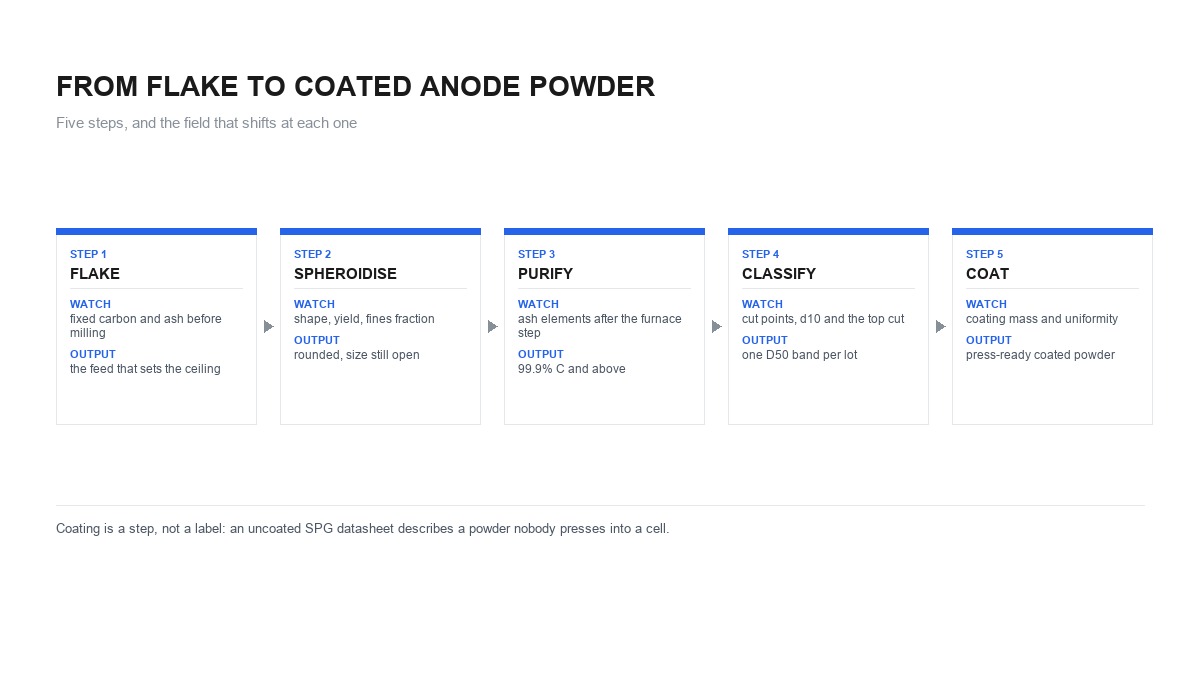
Figure 2. Each step moves a field on the certificate. Coating is the one that changes tap density and surface area at the same time.
The table below is what a working anode specification looks like when it is written to be compared rather than to be admired. Each row is a field, the method that fixes it, and the failure that appears when it is left out.
| Field | Method to fix | What fails without it |
|---|---|---|
| D50 with d10 and top cut | Laser diffraction, same instrument class | A median compared against a distribution |
| Carbon content and ash breakdown | Combustion and element analysis per lot | 0.1% of an unknown mixture |
| Tap density and press density | Tapped volume, then calendered electrode | A powder that packs differently in your press |
| BET surface area, coated | Nitrogen adsorption on the coated powder | First-cycle loss and formation gassing |
| Coating mass and uniformity | Thermogravimetric check plus a stated range | Two coated lots that behave like two products |
| Moisture | Sealed-bag sample, loss on drying | Slurry viscosity drift and gassing |
Receiving an anode lot is closer to a qualification than to a goods-in check. Most plants run the same short sequence, and knowing it in advance is the cheapest way to avoid a hold that has nothing to do with the material.
Bag to certificate. The lot number on the bag matched against the COA, before sampling. Every downstream number is attached to that lot.
Moisture first. Sealed-bag loss on drying, against specification. A wet lot will distort every measurement taken after it, including the surface area.
Size by the declared method. d10, d50 and top cut on the instrument class the specification names. A laser result compared against a sieve result shows a gap that belongs to the method.
Coating state. Coating mass by thermogravimetry, and a visual check on particle surface where the plant has the habit. A coated powder reads differently under the same light than a bare one.
Press trial on a small batch. The one check that cannot be replaced by a certificate: coat, calender, and read the density the line will actually see.
Anode material crosses a border with more paper than a refractory grade, and the file is the difference between a smooth receiving week and a hold. Six documents carry most of the weight in practice.
COA per lot, with the lot number matching the bag, and the fields listed above rather than a carbon figure alone.
MSDS, in the language the plant EHS team files in. Where that language is not English, the translated sheet is the one that gets used, not the English original.
HS classification. Natural graphite sits under HS 2504.10; processed and coated anode grades are classified with the importer, and the classification is worth agreeing before the first booking.
Certificate of origin, including the preferential form where the buyer intends to claim it.
Packing list, with net and gross weight per pallet, because anode powder is usually palletised and the receiving plan depends on it.
Chemical compliance input. Whether an import needs registration depends on tonnage and use, and the importer holds that answer. What a supplier provides is composition, MSDS and a substance identity statement so the check closes quickly.
Anode grades ship from Qingdao by short-sea booking, and the arrival port follows the plant rather than the price: for lines in Northeast Asia the usual two are Busan and Incheon, with Incheon preferred when the plant sits inland and the forwarder consolidates there. Terms are quoted FOB Qingdao or CIF to the named port, and the sailing is confirmed at booking.
Qingdao Xinghe Graphite runs the chain from natural flake through to coated anode powder, which means a buyer can qualify the upstream and the finished grade with one supplier instead of reconciling two certificates from two sources.
Spherical graphite, natural and synthetic feedstock, graded by D50 band
Micro-spherical graphite for finer cuts and higher-surface applications
Standard spherical graphite for anode qualification and volume supply
High-purity graphite at 99.9% carbon and above as the upstream grade
Natural flake graphite, medium and high carbon, as the feed for spheroidising
Packing in small paper bags or one-tonne bulk bags, labelled to the buyer's format
If the incoming specification is still being written, the purchase specification guide covers the fields that belong on it, and how to read a flake graphite COA covers the certificate side. For buyers mapping a plant to a grade across the five demand pools, this overview puts refractory, friction, anode, flame retardant and lubrication on one page.
Is 99.9% enough? It is the entry point, not the answer. Two lots at 99.9% can differ on surface area and coating mass, and that difference is what the cell notices.
Can you supply coated and uncoated? Yes, and the quotation states which. A coated grade is quoted with coating mass and a BET value on the coated product; an uncoated grade is quoted with the BET of the bare powder, which is a different number.
Which grade do we trial first? The band closest to the lot your line already qualified, at the same coating state. Trial a coating change and a size change in one step, and a failure tells you nothing about either.
How tight can the D50 window be? Classification sets the window, and the achievable width depends on the cut points rather than on the grade name. Tell us the d10 and top cut you need and the answer comes back as a range, not a promise.
Do you export anode grades outside Asia? Yes. The same file applies: COA per lot, MSDS, HS classification agreed before booking, origin certificate and packing list.
A useful quotation for anode material needs five inputs: the D50 band and the d10 and top cut around it, the coating state and mass you are qualifying, the carbon limit and the ash elements you screen for, the annual volume with the lot size you receive, and the arrival port with the Incoterm. Send those through the contact form and the reply comes back as a grade recommendation with a lot-based COA sample, not a price list.
Online Message
Leading the Graphite Industry with Innovation and Expertise.
Ma GeZhuang Graphite Mine, Pingdu, QingDao, China
Copyright © 2026 QingDao XingHe Graphite Co.,Ltd. All Rights Reserved.